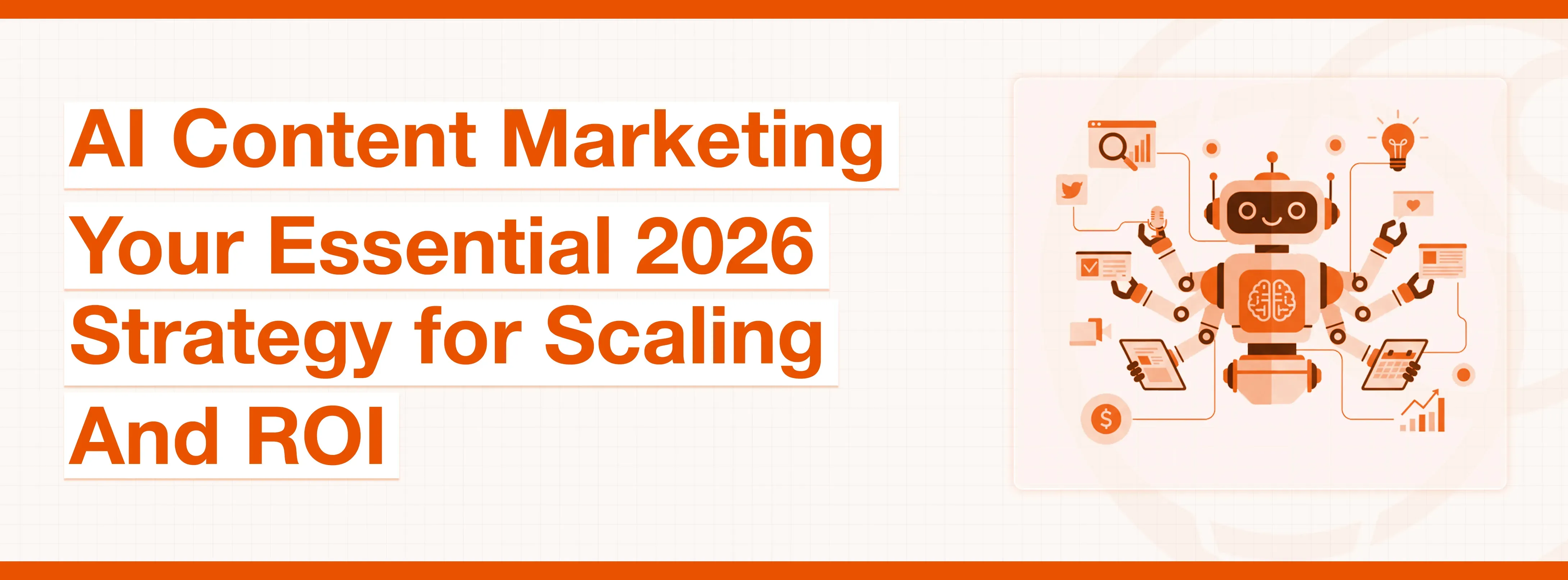
Your Essential AI Content Marketing Strategy for ROI
TL;DR: AI Content Marketing in 2026 is about scaling quality and personalization, not just writing faster. It turns AI into a revenue partner that automates repurposing and delivers a "Netflix-style" experience for every user. With tools like SAAGA SOLVE, you can finally prove which content drives actual sales. The goal is simple. Let the software handle the boring data work so you can focus on human creativity and strategy.
Let's be honest for a minute. As a marketing manager, you are likely tired of hearing about AI Content Marketing as an esoteric, distant, and futuristic idea. It's not. The future has already arrived, and by 2026, it will be all about AI marketing. It is not a story of giant robots creating poetry. This concerns practical and fact-based instruments for AI content marketing that address the most significant issues in our business at present. They already are being used by your competitors to become faster, smarter, and more personal. The real question is, are you?
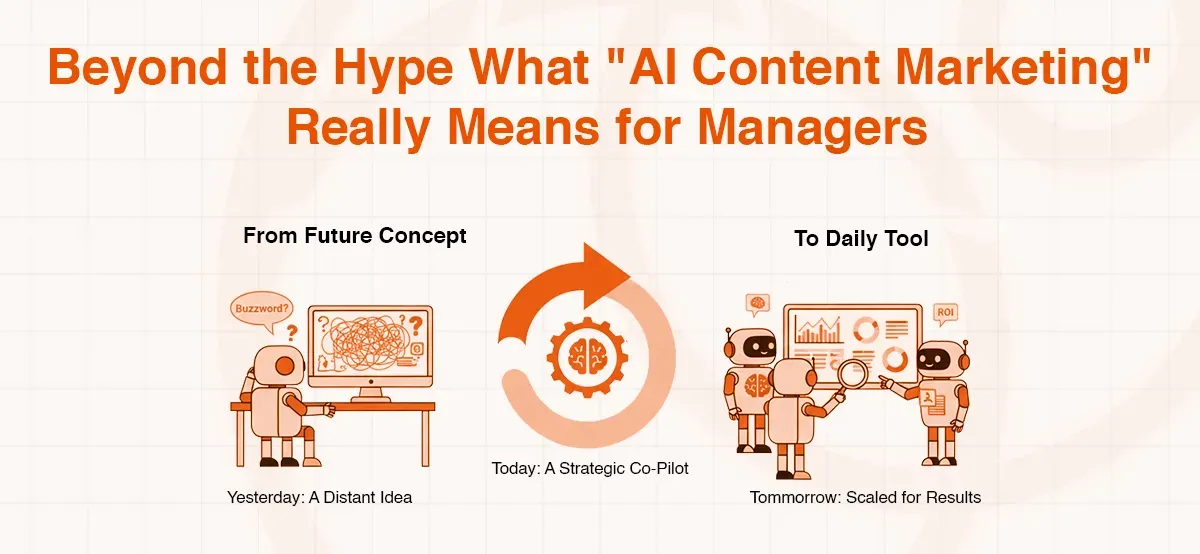
What "AI Content Marketing" Really Means for Managers
It is time to stop treating artificial intelligence content marketing as a tech blog topic and start viewing it as the solution for your weekly reports.
Over the years, AI has remained a buzzword that was included in our strategy presentations. It is now a valuable tool in our dashboards. It does not provide a magic button to simplify your job. You can consider it as a strategic co-pilot. The managers who have gained the most in my experience are those who have ceased to ask what AI is and started asking, "How can AI Content Marketing assist me to reach my Q1 targets?”
How AI Solves the Core Problem of Scaling Quality and Personalization
What is the single issue with every marketing manager? Scaling. We are all expected to:
- Produce more content, higher quality.
- Personalize it according to each user.
- Prove it all goes straight to income.
Doing all of this without increasing the budget used to be an impossible task. This "Quality-Scale-Personalization" triangle is exactly what an AI marketing agency is built to solve.
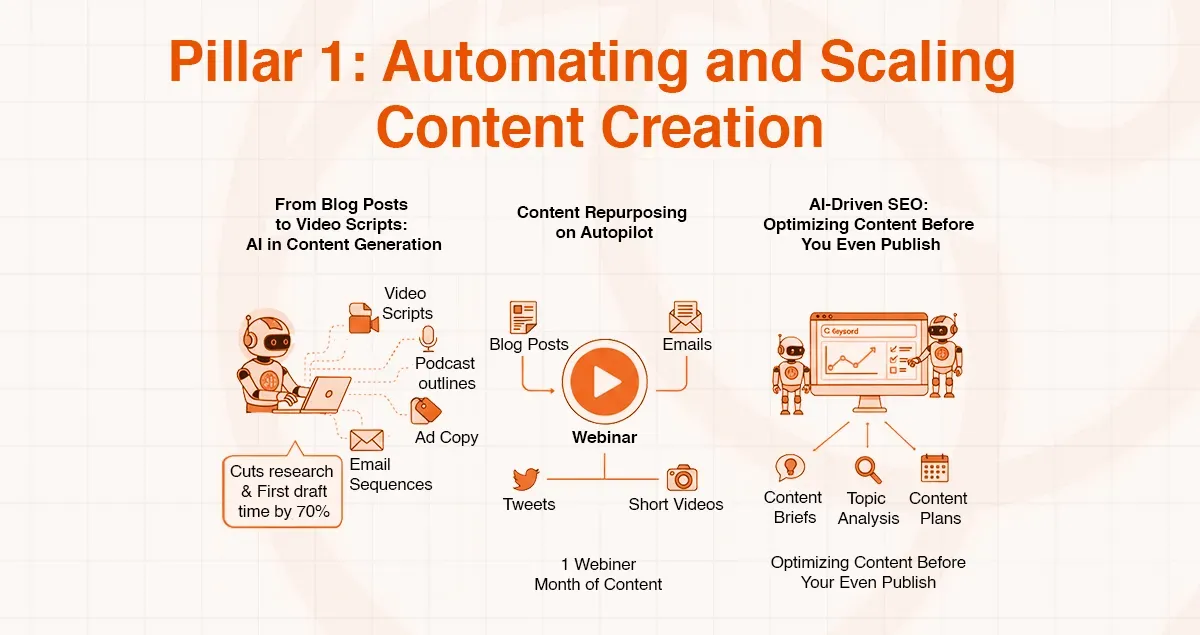
Automating and Scaling Content Creation
It is the most self-evident victory in AI content marketing, though it is far more than blog posts written more quickly.
From Blog Posts to Video Scripts
It is not a secret that there are AI Content Marketing tools that can write a blog post. That's the entry-level stuff. But think bigger. An effective AI platform can produce:
- YouTube and TikTok video scripts.
- Interview questions and podcast outlines.
- Whole email nurture programs.
- Hundreds of variations of ad copies to use in A/B testing.
In my own workflow, using a powerful platform like SAAGA SOLVE doesn't just write for me; it creates a comprehensive internet marketing plan.
Content Repurposing on Autopilot
This is the point of real efficiency. Suppose you have hosted a webinar for an hour, resulting in the production of massive creative content. That one webinar transcript can be instantly transformed by an AI, and it becomes:
- Three 800-word blog posts.
- Twenty prepared tweets containing important quotes.
- Five short video scripts on Reels.
- An overview of your next email newsletter.
- You create one big piece of content, and the AI creates the distribution for an entire month. This is the power of artificial intelligence in action for content marketing.
Optimizing Content Before Publishing with AI-Driven SEO
An AI content strategist does not rely on guessing what to use as a keyword. The top 10-20 ranking pages on your target keyword can be analyzed using modern tools, allowing you to create an information-filled brief on content within minutes. They will give you specifics as to what subtopics you are to discuss, what questions to address, and the length of your article that you need to complete.
Delivering Hyper-Personalization at Scale
When you win the first battle with scaling content in AI content marketing, then personalization is the holy grail of marketing in the contemporary world, and AI is the only solution to do it for each user.
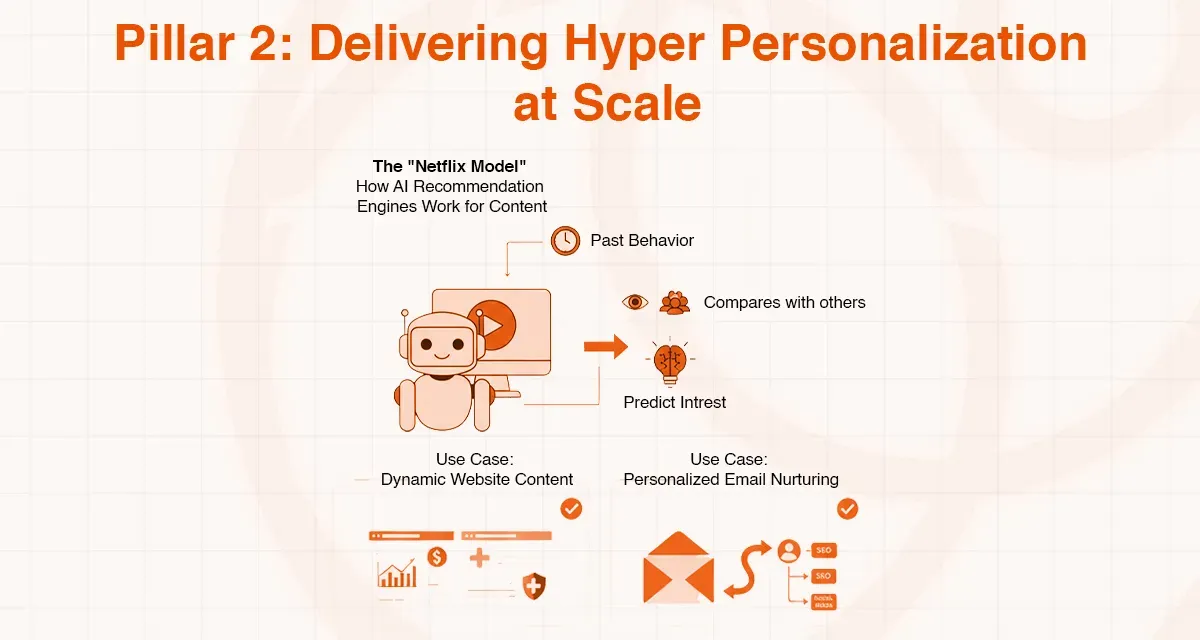
The "Netflix Model"- How AI Recommendation Engines Work for Content
Why does Netflix always know what movie to watch next? It is content personalization, powered by AI Content Marketing. It's an engine that:
- Examine your behaviour in the past (what you have watched or what you have not watched).
- It compares your actions with those of millions of other users just like you.
- Know what you will be most interested in.
At this point, the same technology can apply to your content. An AI can observe the way people use your blog to study their preferences and provide them with the next article, case study, or product page that suits them perfectly.
Dynamic Website Content Use Case
This is a game-changer. Suppose a visitor has come to your homepage. The AI recognizes their industry or location and alters the headline specifically to them. One visitor of a finance company will see The Top Banking Security Trends, whereas one of the visitors of healthcare will see New HIPAA-Compliant Data Solutions. It is not mass marketing at all; it is actually one-to-one communication, and it is totally automated.
Personalized Email Nurturing Use Case
This is much more than a simple use of a [First_Name] tag. An AI-powered email system monitors the user behavior with your content. Were they clicking on the link concerning SEO but not the one concerning social media? The AI will automatically move them into a new sequence of nurture that only provides them with the most relevant tips on SEO and case studies. That is how you establish trust and lead to a lead conversion.
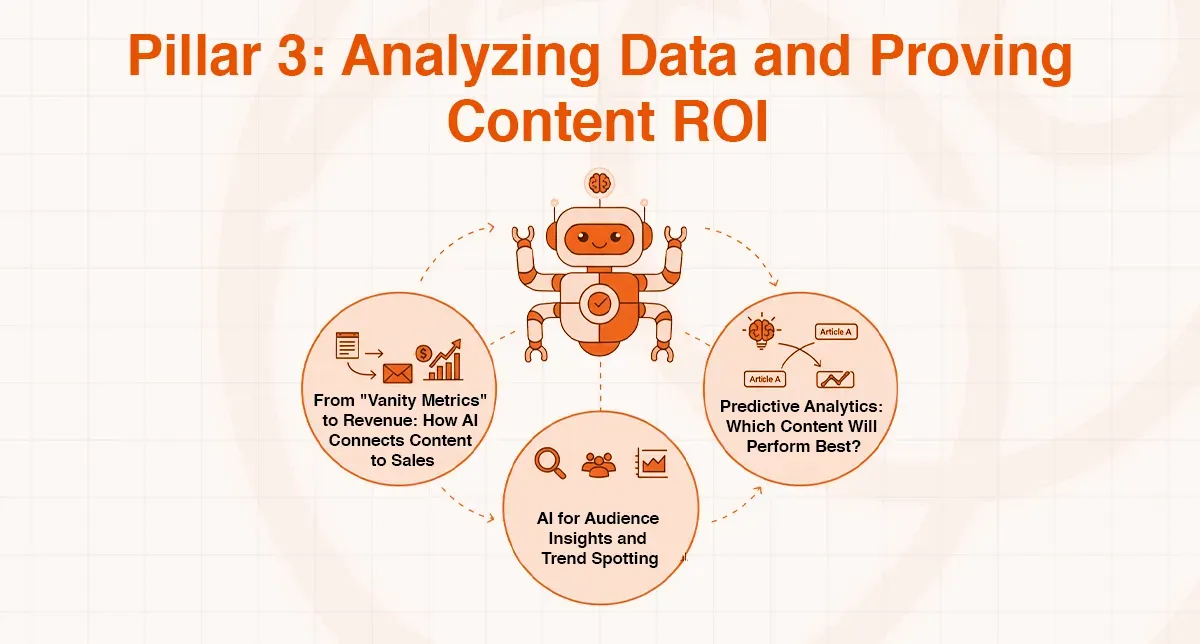
Analyzing Data and Proving Content ROI
This is the pillar that attracts you to a larger budget. We are in a position to relate our content efforts to revenue in a significant way, for the first time ever.
From "Vanity Metrics" to Revenue - How AI Connects Content to Sales
We have all been reporting on the same metrics of vanity, such as page views, likes, and shares, over the years. Who cares? Your CFO wants to see revenue. The actual ROI of AI Content Marketing is that it can tie all the dots. An AI is capable of tracing the whole path of a user, the first post they read on a blog, the email they opened, the demo they registered for, and the final purchase. It is now able, with certainty, to tell you:
"This blog post directly influenced $15,000 in new sales last quarter."
That's the data that matters.
AI for Audience Insights and Trend Spotting
Your customer reviews, support tickets, and types of social media comments are a goldmine of data. But who has time to read it all? An AI tool can. This is where artificial intelligence content marketing proves its value. It can sort through thousands of comments in a few seconds and inform you that 30 per cent of our customers in the Midwest are complaining about this one particular issue. Boom. Your 10 content pieces are there, and all of them are targeted at addressing an established customer pain point.
Predictive Analytics - Which Content Will Perform Best?
In this regard, artificial intelligence content marketing becomes highly impressive as it is fully capable of developing a thorough social media strategy. AI can also predict the success of a topic, instead of having to guess what to write next. It is capable of examining the search patterns, competitor density, and audience intent with the view of assisting you in distributing your resources efficiently. It assists you in answering: should we write Article A or Article B? by estimating which one will lead to more real conversions.
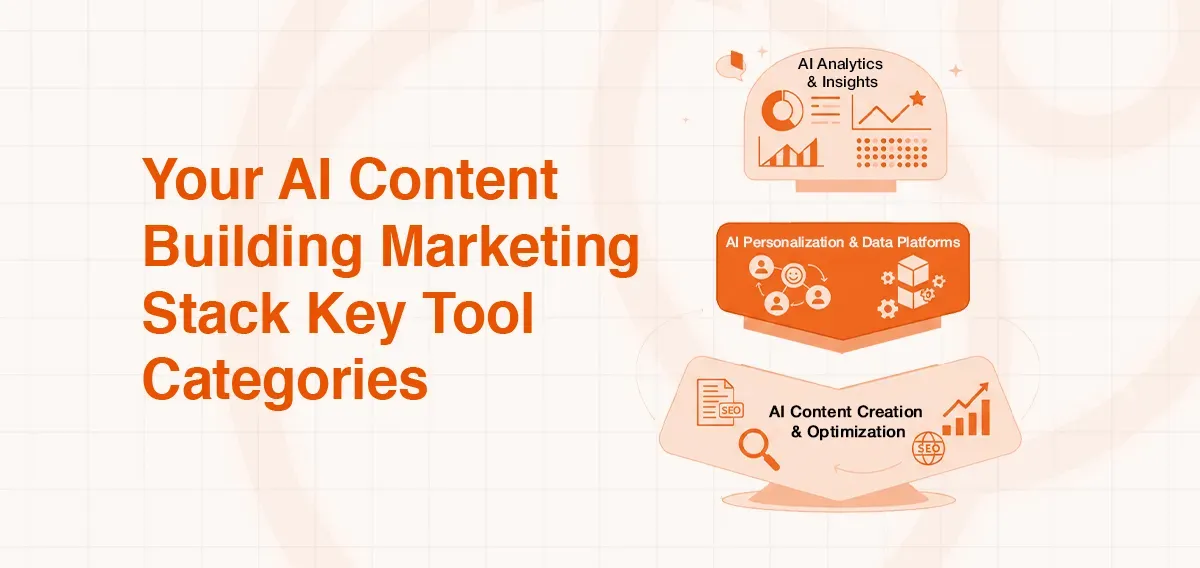
Your AI Content Building Marketing Stack
You do not need a single tool; a stack of tools is required, tools that cooperate. Here's what that looks like:
AI Content Creation & Optimization
This is your foundation. You require instruments to conduct the actual research, write a draft, and do SEO.
Examples: A perfect example of this is SAAGASOLVE, an all-in-one platform. You may also consider professional applications such as SurferSEO for optimization and a general AI tool for writing.
AI Personalization & Data Platforms
This is the driver that provides the appropriate content to the appropriate individual.
Examples: This can be added to your existing platforms. Imagine the AI capabilities of HubSpot, DynamicYield, or the recommendation engine of most online stores.
AI Analytics & Insights
This is your "dashboard." These tools will assist you in knowing the reasons why the users are acting in the manner they are.
Examples: Hotjar (summarizing user behavior with the help of AI) or social listening tools such as Brandwatch.
How to Integrate AI Into Your Existing Content Strategy (A 4-Step Plan)
All right, how can one start without blowing up the whole workflow? Here is a four-step, simple procedure.
Audit Your Current Workflow (Identify Bottlenecks)
Do not attempt to improve everything at once. Identify the largest and stupidest bottleneck in your existing process.
- Do you spend 10 hours researching a new blog posting?
- Do you not repurpose your video material?
- Are you not at all aware of what material is promoting sales? Identify the thing that is slowing you down most.
Start with One Specific Goal
At this point, have a single, specific, and quantifiable objective when it comes to AI.
Bad Goal: We are going to use AI to be better.
Good Goal: Increasing the number of blogs we publish every 2x/month to 8x/month through reducing the time we spend on drafts with AI.
Good Goal: Our welcome email sequence will be personalized with an AI, and the click-through rate will be increased by 15%.
Choose the Right Tool (and Train Your Team)
Select one tool from the stack, based on that single goal. Not ten. Then, train your team. This is what we all miss. The AI tool is futile when your team is unaware of how to compose good prompts or understand the data.
Measure, Iterate, and Scale
Did you hit your goal? Check the data. If it worked, great. Now, back to Step 1 and identify the next largest bottleneck. That is the way you create an AI-powered SEO content strategy, brick by brick, with demonstrated ROI at each stage.
Conclusion
This is no longer a question of 'if'; AI content marketing is already a part of your competitors' blogs, email newsletters, and their sales data. They are already making use of it in order to become quicker, more personal, and efficient.
We have been able to observe how AI is the solution to the problem of scaling. It provides efficiency in AI content marketing, customization in delivering content, and data regarding ROI to see it all come true.
And this is the last point, most important. AI does not eliminate strategists. It replaces tedious tasks. It's a co-pilot, not the pilot. Your work as a marketer is to pose the right questions, target the AI in the right direction, and provide the last, most important layer, human creativity, strategy, and empathy. Artificial intelligence is the what; you remain the why.