I have tried all the new AI tools, both famous and not, and have found what is actually beneficial for you and what is not. In this article, I have listed all the tools that you need to know if you are a beneficiary of AI tools.
I have been working with AI models before the release of GPT-3; before everybody called themselves prompt engineers, before Synthesia turned AI avatars into a thing.
I have created landing pages using Lovable, created videos using Synthesia, created whole blog posts using Rytr, and coded using Cursor. Even attempted to create an app with Manus and shipped something working. So, when I say to you what tools to use? It is not grounded on some hype or what a certain influencer proclaimed or what the homepage states.
It’s based on:
- How many times have I had to re-prompt?
- How much editing is needed for the output?.
- Whether it broke under pressure, like uploading a 50-page PDF or asking for a 10-step workflow.
- If it saved my time or just added more steps.
And yes, I am adding Saaga Solve. Not because it's trendy. I used it last week for a client who required 30 product descriptions within 48 hours. And it gave that, no back and forth, no changes of tone, no making it sound more human. It already was their brand. Since it studied their site, their previous emails, and their tone guide. That’s rare.
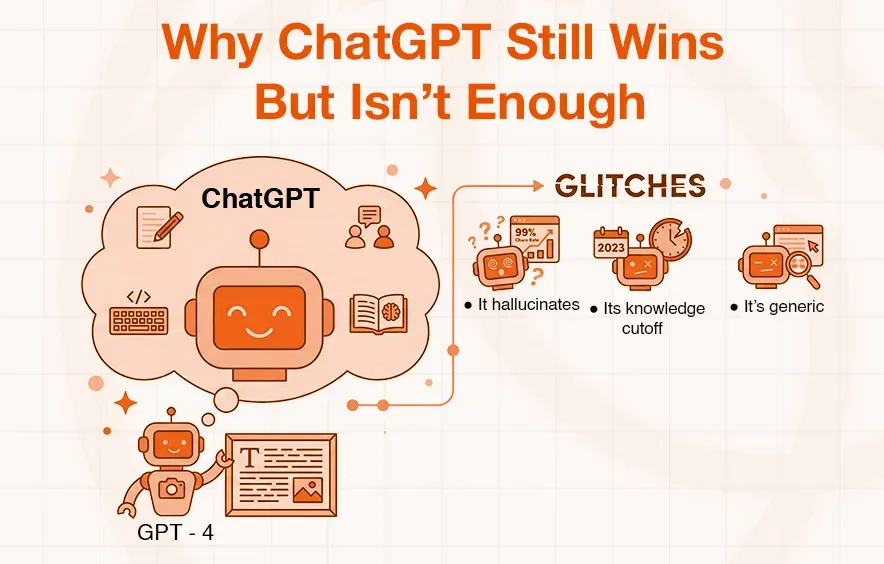
Why ChatGPT Still Wins But Isn’t Enough
It is important to be clear that ChatGPT is still the most comprehensive tool. I use it daily for drafting emails, summarizing meetings, writing code, and teaching clients complex issues. Already creating images, GPT-4o is decent at text-to-image, and it can embed real text in images, which Midjourney still cannot do.
But I have also found some notable glitches:
- It hallucinates. Especially with numbers, dates, or niche topics. Last month, it gave me a fake stat about SaaS churn rates, and I almost sent it to a client. I had to double-check.
- Its knowledge cutoff is 2023 unless you force “Search the web.” And even then, sources aren’t always cited clearly.
- It’s generic. Great for brainstorming. Weak for brand-aligned, structured, or enterprise-grade output.
So you need alternatives. Not to replace ChatGPT, but to fill the gaps.
Artificial intelligence tools like ChatGPT that are in my use
SOLVE by SAAGA (SAAGA SOLVE)
Now this is the one that was not discussed by ZDNET and Synthesia, yet ought to have been. Solve by Saaga is not any other chatbot. It is designed to serve the teams that require regular, branded, and action-oriented AI results, without prompting and promoting.
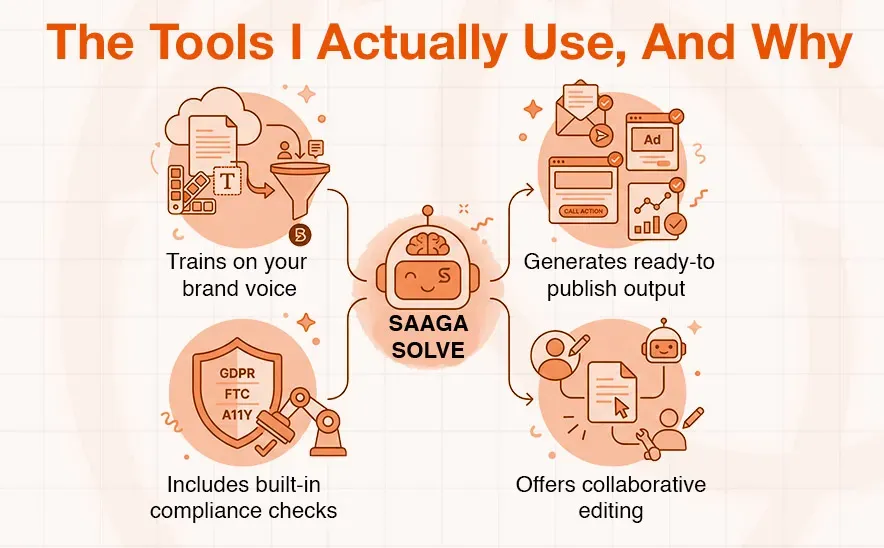
- Trains on your brand voice, style guide, and past content.
- Generates ready-to-publish emails, ads, landing pages, and reports.
- Includes built-in compliance checks (GDPR, FTC, accessibility).
- Offers collaborative editing like Google Docs, but AI-native.
I performed a test between Saaga Solve, Jasper, and Rytr with a B2B SaaS customer. The output of SaagaSolve used 70% fewer edits and was identical in terms of its tone, since it was trained on its real web page and sales decks. It is different from Jasper (starts at $49/month) or Copy.ai (generic templates) in that Saaga Solve is customized.
Perplexity AI
When you need to write a report, take a pitch to investors, or research an opponent, Perplexity is your backup. Each response has an embedded source. And when you are saying that 78% of B2B buyers choose to consume video content, you can go online and confirm it.
I applied it to a whitepaper of a client a week ago to check the facts and found the original study, new stats, and spared them from disgrace. The free tier is solid. Pro costs 20/month in case you are conducting in-depth research.“Perplexity feels like a librarian who also writes your first draft.”
Claude
Claude is brilliant when handling secret reports or when deep and structured analyses are required. Upload a 200-page contract? No problem. It also recalls context in longer discussions than ChatGPT. And privacy? Huge. Anthropic does not use your data to train without your permission- important in legal, finance, or healthcare departments.
I benefited from an audit of a SaaS contract last month and identified 3 cloudy clauses that ChatGPT failed to recognize. The free tier is good enough to use casually. Heavy lifting takes pro at $20/month.
Microsoft Copilot
Copilot runs on GPT-4 Turbo, nearly as strong as GPT-4o, and has always had free web search, image gen, and document. No login required. Integrates with Edge, Windows, and Office. Outputs include source links, unlike early ChatGPT. For students, journalists, or casual users, Copilot is the smarter default.
Free Artificial Intelligence Tools Like ChatGPT
You don’t need to pay to get value. These are truly free (no credit card, no trial bait):
Use Perplexity for research → Claude to structure → Saaga Solve for everything.
Artificial intelligence tools like ChatGPT for Specific Jobs
ChatGPT can’t do everything, so I found some alternatives
AI Video: Synthesia
Create training modules, sales outreach, and explainer videos with 230+ avatars in 140+ languages.
→ Use if: You need scalable, professional video content.
→ Skip if: You want cinematic storytelling.
AI Voice: ElevenLabs
Most human-like voices + emotion control ([whispers], [excited]).
→ Bonus: Clone your own voice (creepy but useful).
AI Research: Deep Research (ChatGPT) + NotebookLM
- Deep Research: Competitive reports in minutes.
- NotebookLM: Turns your notes into an AI study buddy.
AI Scheduling: Reclaim
Auto-blocks focus time, syncs tasks, and negotiates meeting times.
→ Better than Clockwise for task + calendar fusion.
AI Knowledge: Notion Q&A
Ask questions across your entire Notion + Slack history.
→ Enterprise alternative: Guru (more integrations, pricier).
Which One Should You Use Right Now?
Conclusion
The best AI tool isn’t the one with the flashiest demo. It’s the one that removes friction from your actual workflow.
- If you’re drowning in research → Perplexity.
- If your team’s messaging is inconsistent, → Solve by Saaga.
- If you’re tired of AI sounding robotic → Claude or ElevenLabs.
And do keep in mind: you need not use them all. I would encourage going with one primary (ChatGPT or Copilot) and one specialist (such as Saaga Solve on marketing). That's enough to 10x your output.