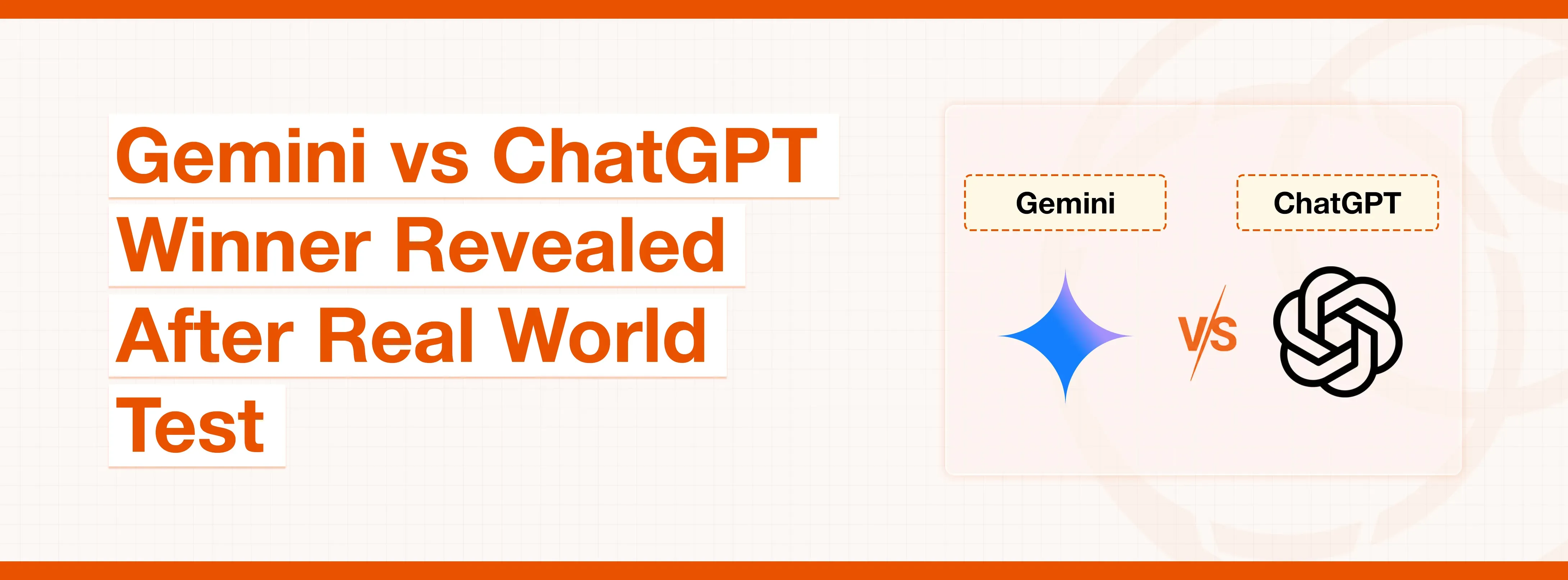
Gemini and ChatGPT are two powerful AI assistants designed to support content creation, research, coding, and productivity. ChatGPT stands out for its creativity, flexibility, and strong ecosystem of plugins, agents, and integrations, making it ideal for marketing, writing, and workflow automation. Gemini, developed by Google, excels in real-time research, multimodal capabilities, and deep integration with Google Workspace tools like Docs, Gmail, and Sheets. While ChatGPT is often preferred for creative writing and customization, Gemini performs well for structured tasks, analytics, and productivity workflows.
Whether you are a marketer, a writer, or a brand strategist, Gemini and ChatGPT must be an essential part of your toolkit. Their versatility, ease of use, and accuracy have made them a popular choice amongst digital marketers. Although GPT could rightfully be named the pioneer of AI writing/research tools, Google’s Gemini has quickly evolved to become a top contender.
As businesses increasingly rely on AI to scale content production, streamline research, and optimize campaigns, choosing the right AI assistant has become more important than ever. Both Gemini and ChatGPT offer powerful capabilities, from generating long-form content and ad copy to analyzing data and answering complex queries. This makes them valuable assets across multiple marketing functions.
However, the way these tools perform can differ significantly depending on the task at hand. Factors such as content quality, contextual understanding, speed, integrations, and real-world usability often determine which AI delivers better results. In this comparison, we’ll put Gemini and ChatGPT to the test to see which platform truly stands out for marketers and content professionals today.
Fortunately, with SAAGA Solve, you can leverage the benefits of both tools on a single platform. Let’s delve into the highly popular Gemini vs ChatGPT discussion to unveil the pros of these tech giants.
What is ChatGPT?
ChatGPT is a conversational AI tool developed by OpenAI, powered by the GPT‑5 family of models. GPT is a standalone tool and operates independently of any single software suite. What makes ChatGPT a top-rated AI tool is its ease of use, flexibility, and creative depth.
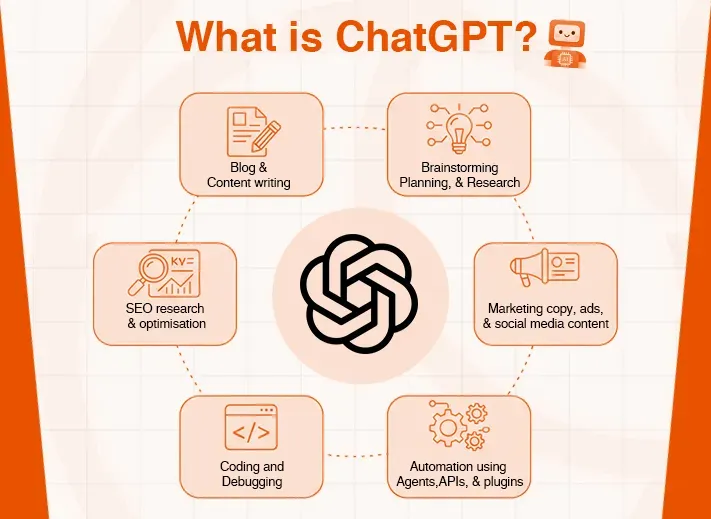
ChatGPT is widely used for:
- Blog and long-form content writing
- SEO research and optimisation
- Coding and debugging across multiple languages
- Brainstorming, planning, and research
- Marketing copy, ads, and social media content
- Automation using agents, APIs, and plugins
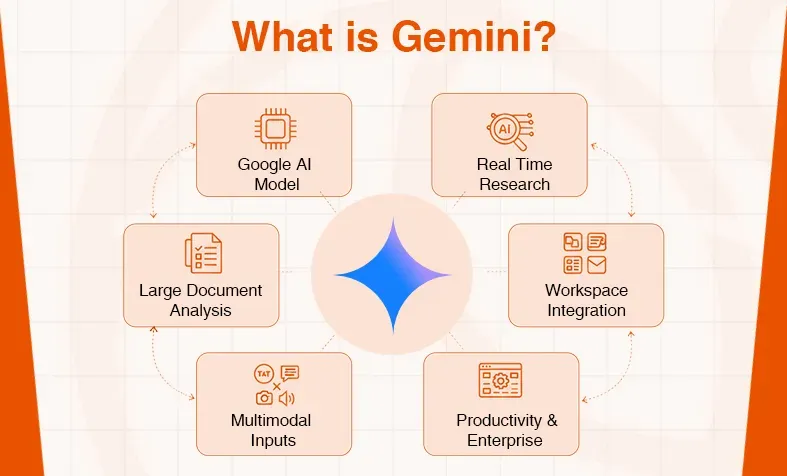
What is Gemini?
Gemini is Google’s next-generation artificial intelligence model designed to assist users with research, content creation, data analysis, and productivity tasks across Google’s ecosystem. Built to handle text, images, audio, and video, Gemini aims to deliver fast, accurate, and context-aware responses while seamlessly integrating with tools people already use every day.
Key features of Gemini include:
- Developed by Google and powered by the Gemini model family
- Strong capabilities in real-time research using Google Search
- Ability to handle large context windows for long documents and complex analysis
- Deep integration with Google Workspace tools such as Docs, Gmail, Sheets, and Drive
- Support for multimodal inputs, including text, images, audio, and video
- Designed for productivity, fact-based tasks, and enterprise use
Quick Comparison - Gemini vs ChatGPT
Take a closer look at how top AI tools compare when it comes to performance, cost, capabilities, and user experience.
Plus: $20/month
Pro: $200/month
Team: $25/month/user
Google AI Pro: $19.99/month (one month free)
Google AI Ultra: $250 (50% off in first 3 months)
Plus: $20/month
Pro: $200/month
Team: $25/month/user
GEMINI :Google AI Pro: $19.99/month (one month free)
Google AI Ultra: $250 (50% off in first 3 months)
How Do ChatGPT and Gemini Stack Up Against Each Other?
Here’s a list of similarities and differences between Google’s Gemini and OpenAI’s ChatGPT:
Similarities
- Both are state-of-the-art AI models capable of generating text, answering questions, coding, and performing complex reasoning tasks.
- Support multimodal capabilities, including interpreting text, images, and other media for richer outputs.
- Offer enterprise-level features for businesses, developers, and workflow automation.
- Strong performance in content creation, research assistance, summarization, and productivity tasks.
- Continuously improving with new model updates, expanded features, and better accuracy over time.
Differences
Underlying Technology & Ecosystem
- ChatGPT is developed by OpenAI and built on the GPT-4 family (plus newer variants), focusing on broad usability and developer integrations.
- Gemini is Google’s AI, using the Gemini model family with tight integration into the broader Google ecosystem (Search, Workspace, Gmail, Drive, Maps, YouTube). This affects how each tool interacts with user data and other apps.
Data Access & Real-Time Information
- Gemini can pull live data from the internet via Google Search, giving it an edge in up-to-date factual queries and research-style answers.
- ChatGPT’s defaults rely on a fixed training cutoff (though it only accesses current web info when specific search/browsing features are enabled).
Context Handling & Large Tasks
- Gemini typically supports much larger context windows, up to ~1 million tokens, making it better at handling very long documents, books, or research workflows.
- ChatGPT’s context limits are smaller (e.g., ~128k tokens), though still ample for most everyday uses.
Integration & Workflow Fit
- Gemini’s deep Google integrations (e.g., export to Docs, auto-summarize Gmail, analyze Sheets) make it powerful in productivity and enterprise workflows, especially for organizations already using Google Workspace.
- ChatGPT, while versatile, integrates more broadly via APIs and external plugins but lacks the same built-in tie-ins to Google’s core productivity tools.
Strengths in Use Cases
- ChatGPT is often preferred for creative writing, conversational fluency, and coding support, and many users find it more natural for detailed text generation.
- Gemini tends to excel at fact-grounded research, structured outputs, and advanced multimodal reasoning across text, image, audio, and video. Depending on the task (creative vs. analytical), users may prefer one over the other.
Gemini vs ChatGPT Performance Overview: Which Tool Works Better?
To get the most benefit from each tool, it’s crucial to understand its strengths and weaknesses. Each AI tool specializes in a few tasks, and using it for that purpose will yield a high-quality result. Here’s a breakdown of how Claude and ChatGPT perform across the most critical dimensions that matter for modern teams.
Strengths
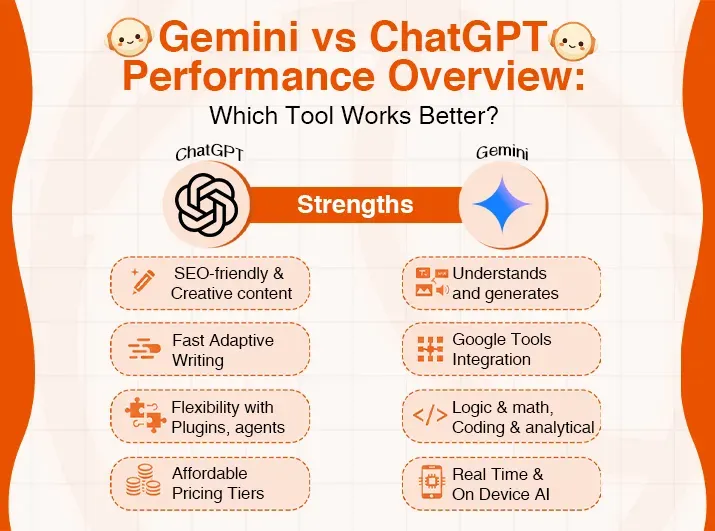
ChatGPT:
- SEO-friendly, creative, high-engagement content. It writes faster and adapts easily to brand tone, making it ideal for blogs, landing pages, and marketing campaigns.
- Offers strong context retention as well, especially in GPT-5, but it’s more optimised for interactive, rapid-response tasks.
- Provides unmatched flexibility with plugins, agents, and a massive ecosystem - ideal for marketers, developers, and automation teams building AI-powered workflows.
- Offers affordable tiers for individuals and powerful Pro options for teams scaling high-volume content.
Gemini:
- Understands and generates text, images, audio, and video for richer, more dynamic outputs.
- Works seamlessly across Search, Docs, Sheets, Gmail, Drive, and Android for boosted productivity.
- Strong performance on logic, math, coding, and complex analytical tasks.
- Optimized for real-time and on-device performance with Gemini Nano running directly on Android devices for fast, private AI assistance.
Weaknesses
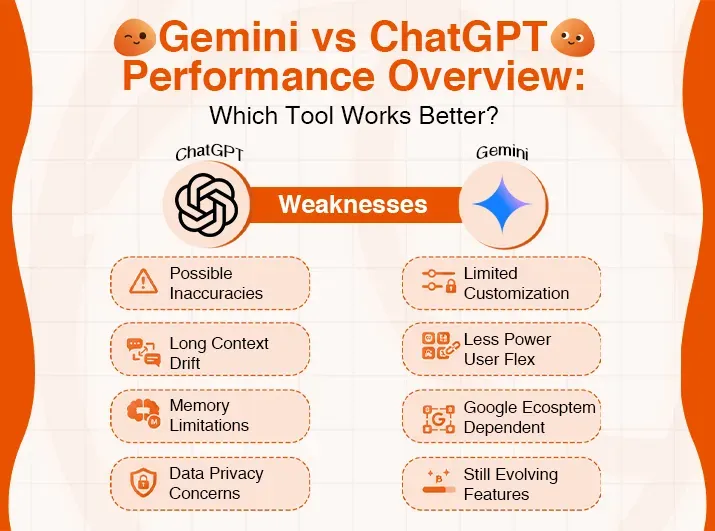
ChatGPT:
- ChatGPT can still produce confident but factually incorrect answers, especially on niche or rapidly changing topics.
- In very long chats or multi-document workflows, it may lose track of earlier details or shift tone over time.
- Memory isn’t perfect. While persistent memory exists, it doesn’t always handle highly complex, deeply layered, or extremely long-term context reliably.
- Unless users adjust their settings, conversation data may be used to improve the model, which can be a consideration for privacy-focused teams.
Gemini:
- Limited customization options for creating custom agents or workflows compared to ChatGPT.
- Less flexible for power users as advanced features are more guided and structured, which can restrict highly creative or unconventional use cases.
- Potential over-reliance on the Google ecosystem, as it works best within Google apps, which may limit integration with non-Google tools.
- As a newer AI, some features and capabilities are still being refined, and documentation or support may be less extensive than those of more advanced models.
Choose Gemini for structured, reliable, and multimodal AI support.
Choose ChatGPT for creative, flexible, and highly customizable workflows.
Use Cases of OpenAI’s ChatGPT & Google’s Gemini
Curious what these AI tools can actually do? Let’s break it down.
Gemini & ChatGPT - Performance Test
There’s no single winner between Gemini and ChatGPT as both are top-of-the-line AI assistants. However, each tool excels in performing a specific task, and that is where one can harness its true potential.
Market Research & Trend Analysis
Winner: Gemini
Scenario: A marketer needs the latest industry trends, competitor updates, or news-based insights.
Why: Gemini leverages Google Search for more current, fact-based information, making it better for real-time research and data validation.
Blog Writing & Creative Content
Winner: ChatGPT
Scenario: A content writer needs engaging blog posts, storytelling, brand-aligned copy, or human-sounding long-form content.
Why: ChatGPT generally produces more natural, fluent, and creative writing, especially for marketing and editorial use.
Email, Docs & Workflow Productivity
Winner: Gemini
Scenario: A team wants to summarize emails, draft responses, analyze spreadsheets, or collaborate inside Google Docs and Sheets.
Why: Gemini’s native integration with Google Workspace makes it faster and more seamless for day-to-day productivity tasks.
Let’s put these tools to the test with a real-world prompt comparison.
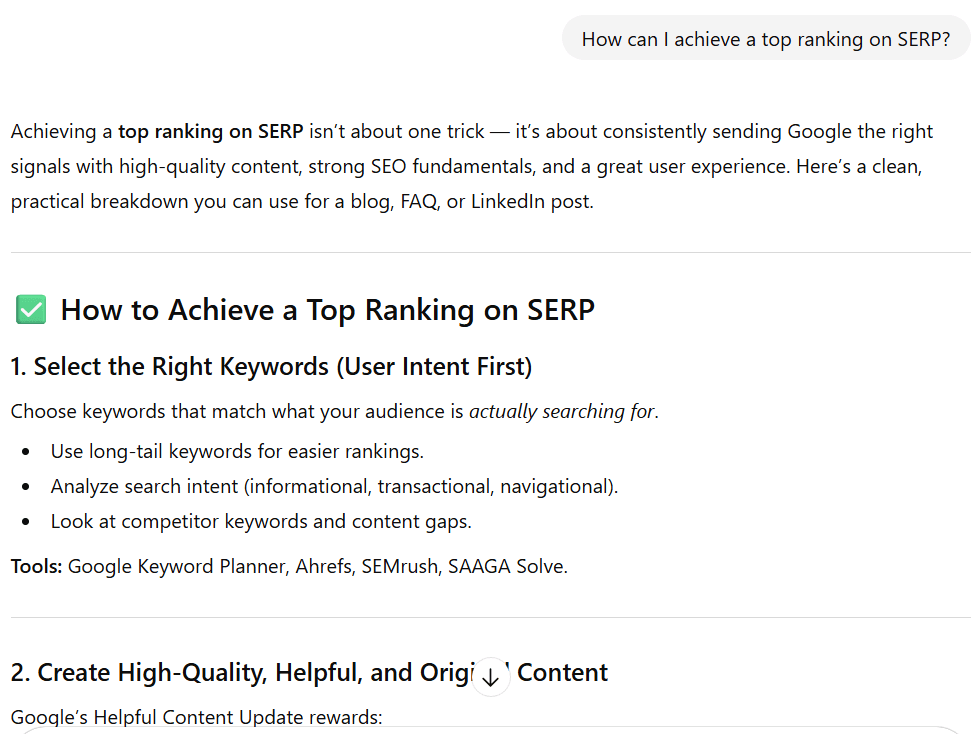
Prompt: “How can I achieve a top ranking on SERP?”
ChatGPT’s response:
Gemini’s response:
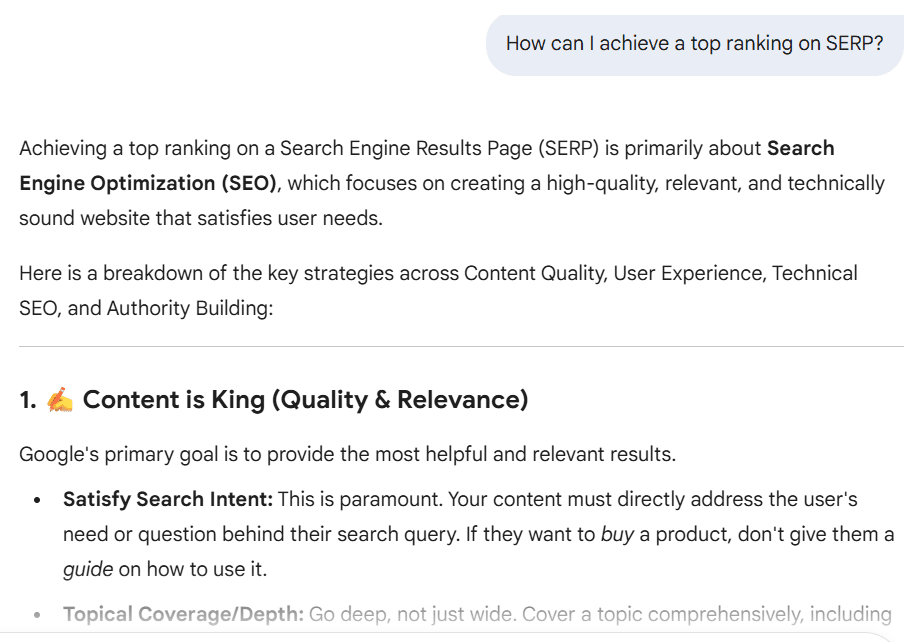
Both AI engines acknowledge the need for quality content to achieve your desired ranking on SERP. While Gemini is more focused on content quality and relevance, GPT also highlights the importance of SEO, i.e, proper keyword usage, search intent analysis, etc.
Gemini vs ChatGPT: Who Has The Winning Edge?
Gemini and ChatGPT are two of the most popular AI tools, each with its own strengths and use cases. While their performance is at par with each other, their ideal use cases differ. A smart approach would involve leveraging both tools for performing various tasks. Gemini stands out with its multimodal capabilities, deep integration across Google Workspace, advanced reasoning, and real-time performance on devices. On the other hand, ChatGPT excels in creativity, customization, and versatility, with a vast ecosystem of plugins, agents, and integrations.