
See how a single prompt creates your SEO workflow.
The SaagaSolve Content Workflow | Use Agentic AI for Content Creation
TL;DR: Agentic AI for content creation is a multi-agent system where specialized AI agents handle research, SEO analysis, writing, fact-checking, and final assembly to produce publish-ready articles in approximately 45 minutes. Human-in-the-loop checkpoints are integrated to give quality control to specialists.
Writing a single, high-quality article takes almost the better part of a workday. First, deep research is necessary to identify content gaps and novel angles. Brand voice alignment to ensure every paragraph matches client guidelines. SEO data integration, including entities, NLP terms, People Also Ask questions, and SERP analysis, is all important to meet quality standards. And then the professional performs QA, fact-checks, and final improvement before submission. For senior SEOs and content strategists, all of this is an everyday responsibility.
Agentic AI for content creation has completely automated this process. Instead of using a single tool for one task and another for the next, an AI content production pipeline handles research, SEO analysis, writing, fact-checking, and final assembly with human review where needed. As a result, experts get a publish-ready, SEO-optimized article in approximately 45 minutes. Let's understand this in detail.
Understanding The Problems in Modern-Day Content Production
The majority of content teams are familiar only with the manual loop. One article requires proper SERP research, competitor analysis, content gap mapping, brief drafting, writing, editing, fact-checking, and SEO optimization. When that content needs to be repurposed for multiple channels, such as a blog, LinkedIn, and YouTube, the amount of manual work significantly increases.
This is really overwhelming. Completing these multiple tasks requires writers 6-8 hours. Imagine doing that for several clients or multiple articles every week. Teams end up spending most of their time producing content instead of planning and improving it.
The Single-Tool Trap
The introduction of generative AI tools was supposed to solve this for specialists, but most teams end up falling into the single-tool trap. They use ChatGPT for drafting, a separate tool for keyword research, another for SEO optimization, and still another for fact-checking. Switching between these tools is not agentic AI content creation. People have to copy and paste information, rewrite prompts, and manually combine outputs. Instead of saving time, they become the link connecting tools that don't work together.
This is not a smooth AI SEO content workflow. It slightly reduces time per article but introduces more effort for context switching, inconsistent brand voice, fragmented quality control, and the persistent need to babysit each tool's output. The fundamental architecture of the workflow hasn't improved. The only difference is that the work is divided between multiple AI tools instead of being done manually.
Now, a single tool cannot manage this whole process. Specialists need a system that includes content workflow automation tools, much like a content team orchestrates specialized roles.
What Is Agentic AI for Content Creation?
As you can see in this video, agentic AI for content creation has multiple specialized AI agents. Each one performs a distinct function, including research, SEO analysis, writing, fact-checking, and final assembly. With multi-agent AI content, Laura gets publish-ready articles in approximately 45 minutes. Regardless of how many are being processed, 10 or 100, all will be crafted within this time period. Human-in-the-loop checkpoints give her complete control over content quality and brand alignment.
Agentic AI vs. Generative AI: The Critical Distinction
Generative AI generates content from a single prompt. It's a one-step iteration. You give input and get your desired output with the least possible revisions required. This means the quality of the content depends on the prompt and the human's ability to iterate.
On the other hand, Agentic AI operates differently. An agent is like an AI team member with a defined role, persistent memory, specific output standards, and the ability to delegate to or coordinate with other agents. This showcases one model for one task. In a system of multiple agents, each does one thing exceptionally well, and a coordinating layer synthesizes their work.
| Dimension | Generative AI | Agentic AI |
| Architecture | Single model works based on a prompt | Multiple agents, orchestrated pipeline |
| Specialization | A generalist to do various duties moderately | Specialized for a defined role |
| Memory | Session-limited, no persistence | Persistent brand profiles, client memories, project context |
| Quality Control | Humans do all QA manually | Built-in review loops with scoring thresholds |
| Scalability | Linear because one prompt is processed at a time | Parallel. All agents perform their duties simultaneously |
| Human Involvement | Constant babysitting | Strategic checkpoints only |
Inside the SaagaSolve Content Workflow
Now, we will learn how an agentic AI workflow operates inside SaagaSolve. A seasoned SEO specialist, Laura Cardona, explains how to craft a publish-ready article with just a single prompt.
Client Onboarding and Brand Profiling
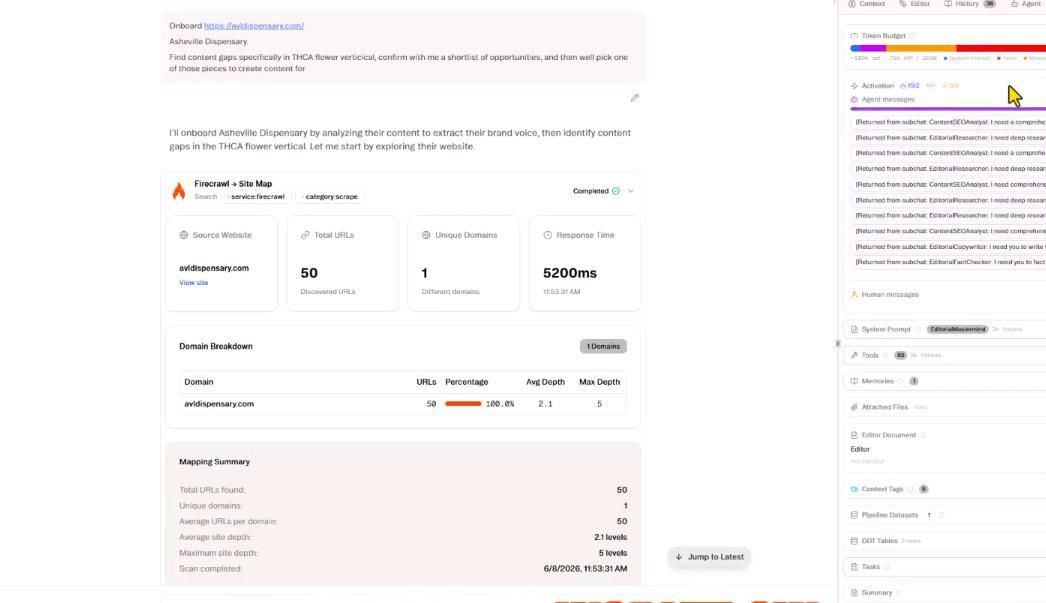
She starts the workflow with client onboarding. A command, "onboard Asheville Dispensary," triggers SaagaSolve to research the client and automatically generate a brand profile. This includes brand guidelines, voice and tone parameters, unique selling propositions, and relevant industry context.
Once the brand profile is created, SaagaSolve saves it as part of the client's memory. Every new content request automatically uses this information, so there's no need to repeat the same instructions each time. The AI already understands the client's brand voice, target audience, and messaging, helping keep content consistent across every piece.
For the demonstration, the practitioner onboarded a dispensary client. SaagaSolve created a complete brand profile visible in the platform's memory panel, ready to inform every piece of content produced for that account.
Content Gap Analysis and Opportunity Identification
With the client profile established, the next command identifies content gaps within a target vertical. The practitioner specified the THC flower vertical, a primary keyword target for the client. SaagaSolve's agents then executed a series of analyses without human intervention:
- SERP analysis: What does the current ranking landscape look like?
- Search intent mapping: What are users actually looking for?
- Editorial research: What unique information can be surfaced that isn't covered by existing SERP results?
- General fact gathering: What baseline information should the content include?
These sub-analyses ran as parallel sub-chats between specialized agents. Each contributes its findings to the collective research base.
Human Checkpoint - Topic Selection
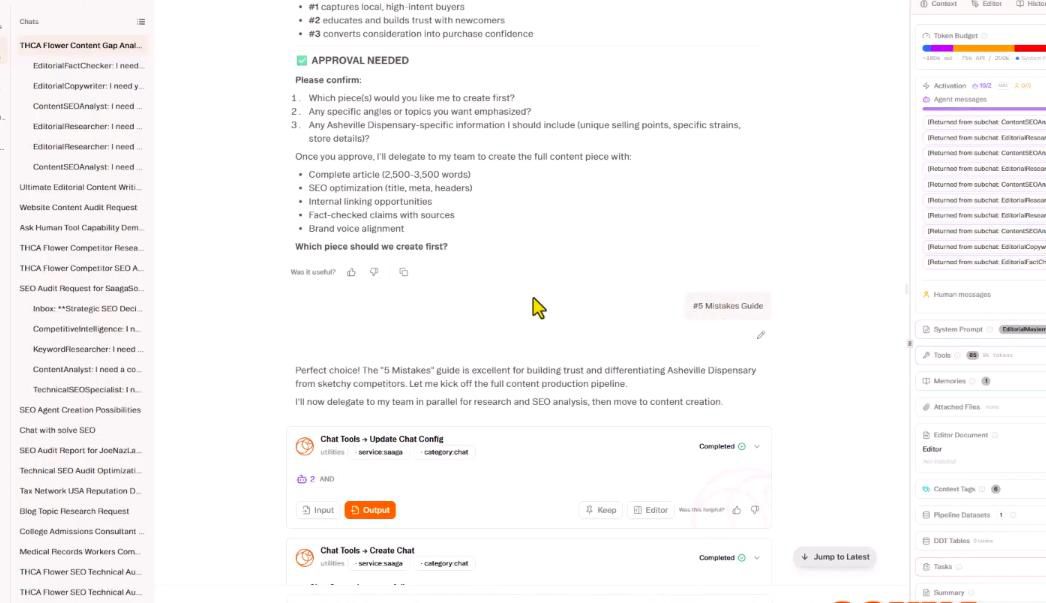
There are pauses in this process for a human checkpoint. That's where SaagaSolve presented a shortlist of five recommended content opportunities with explanations of why they were selected.
The practitioner reviewed the recommendations in a clean table format:
| Recommended Topic | Difficulty | Traffic Potential | Business Impact | Time to Rank |
| Top Mistakes Guide | Low | Good | Very High | Quick |
| Topic 2 | Medium | High | Medium | Moderate |
| Topic 3 | Low | Medium | High | Quick |
| Topic 4 | High | High | High | Slow |
| Topic 5 | Low | Low | Medium | Quick |
Laura selected "Top Mistakes Guide" because it offered the best balance of low difficulty, strong traffic potential, high business impact, and a quick time to rank. This decision is all SaagaSolve needed to continue the AI workflow content creation.
This is one of the built-in human checkpoints in the process. This content automation for SEO teams allows them to focus on choosing the right direction. Once the topic is approved, SaagaSolve takes over execution, while the strategist retains control of the final decision.
Comprehensive Content Brief Generation
A comprehensive content brief is generated when the topic is confirmed. This brief incorporates:
- SEO data from the SERP analysis (target keywords, entities, NLP terms)
- Editorial research findings (unique angles, differentiating information)
- Brand voice parameters from the client's persistent profile
- Structural recommendations based on competitive analysis
The brief was then automatically routed to the next agent in the pipeline to proceed the flow.
Draft Writing with Brand Voice
The Editorial Copywriter agent received the content brief and produced a full draft accordingly. The draft followed the client's brand voice automatically because SaagaSolve had already stored the brand profile during onboarding. There was no need to paste brand guidelines or repeatedly prompt the AI to "write in this tone." The system already understood the client's voice and applied it consistently throughout the draft.
Fact-Checking Pass
Afterward, this content passed through the Editorial Fact Checker. It is a dedicated agent whose only function is to verify claims, cross-reference sources, and flag any unsupported statements. This is not a human reading the draft where writers hope nothing will be wrong. It's a systematic, automated verification pass.
SEO Optimization and Final Assembly
The last task belongs to the Mastermind Agent. This coordinating agent performs final assembly, including SEO optimization, title tag, and meta description generation, internal linking, and overall quality assurance.
The output included:
- Optimized title tag
- Meta description
- Target keywords
- Word count and reading time
- Full article body with internal links which generated without explicit prompting
This Agentic AI content creation system takes around 45 minutes from prompt to output. All procedures work in the background. Laura spent approximately 30 seconds approving the topic selection
Why Multi-Agent AI is Better than Generic AI Tools?
You might be thinking, why choose agentic AI for content creation over generic AI tools. Although there are many benefits of this shift, we will study the main ones below:
Persistent Memory and Brand Consistency
Most AI marketing tools don't remember previous conversations or client details. That means brand guidelines, client context, and writing preferences often have to be provided again for every new piece of content. Repeating the same instructions over and over is the same as adding unnecessary work to the process.
SaagaSolve has a different approach. Once a client is onboarded, their brand profile is stored in the platform. Every agent involved in future workflows automatically uses that profile to maintain the brand voice and messaging without needing to re-enter the same information every time.
Quality Assurance Without Human Bottlenecks
The ContentReviewAgent serves as a critical quality-control layer on content. Instead of relying on a human to observe and correct errors, the system scores each draft against defined standards after improvement. An 80/100 threshold ensures only quality content advances to delivery.
This is not to remove the human from quality control. It levels up the human's role. Instead of line editing and fact-checking, the senior practitioner reviews content that has already been through automated QA. They apply the final strategic judgment, the "chef's kiss" that transforms good content into masterful content.
Jira Integration Ensures Team Alignment Without Manual Updates
SaagaSolve can be connected with multiple platforms, so teams using Jira can automate repetitive tasks after integration. Each stage of the pipeline can trigger automatic ticket updates, keeping the entire team informed without manual status reports. A content manager or Jira manager has instant visibility into the pipeline. They see exactly whether a content piece is in research, drafting, or fact-checking, without having to ask anyone for a status update.
What the 45-Minute Benchmark Means for Content Teams
When Laura mentioned a 45-minute turnaround, it's not a marketing pitch. It's the real, end-to-end production time. During this period, everything is covered from the initial prompt and deep research to thorough drafting, fact-checking, and final SEO assembly.
Where the Time Goes
Phase | Duration | Human Involvement |
Client onboarding (one-time) | ~5 minutes | Single command |
Content gap analysis | ~10 minutes | No, fully automated |
Topic selection checkpoint | ~30 seconds | Human approval |
Parallel research (SEO + editorial) | ~10 minutes | None, fully automated |
Content brief generation | ~5 minutes | No, fully automated |
Draft writing | ~10 minutes | No, fully automated |
Fact-checking pass | ~5 minutes | No, fully automated |
SEO optimization & final assembly | ~5 minutes | No, fully automated |
Total | ~45 minutes | ~30 seconds of human time |
What's Automated vs. What Requires Human Review
The automated components include research, analysis, drafting, fact-checking, and SEO optimisation. The specialist has to strategically select the topic, final QA, and the creative polish that transforms a strong draft into a masterful piece.
The system doesn't replace the senior experts. It eliminates the nitty-gritty that prevents them from doing junior-level work. When a seasoned SEO receives a draft that's already researched, SEO-optimized, fact-checked, and brand-aligned, they spend their time on strategy instead of production mechanics.
Comparing The Old & New Workflows
The Old Way (Single Article):
- Deep research: 1–2 hours
- Brand voice alignment: 30 minutes
- SEO data integration: 45 minutes
- Writing: 2 to 3 hours
- Fact-checking: 30 to 45 minutes
- QA and editing: 30 to 60 minutes
Total: 6 to 8 hours per article
The SaagaSolve Way (Single Article):
- Initial prompt: 1 minute
- Topic approval checkpoint: 30 seconds
- Automated pipeline execution: ~45 minutes (background)
- Final human review and polish: 15 to 30 minutes
Total: 15 to 30 minutes of active human time
Scale Implications
The real advantage of a 45-minute workflow is when you scale the content. Instead of waiting for one article to finish before starting the next, teams can get multiple workflows simultaneously. During the 45-minute execution, several articles can move through the entire research-to-delivery process in parallel.
For smaller teams, this means producing more content without increasing manual work. Larger teams can spend less time on repetitive production tasks and more time on strategy, client relationships, and business growth.
How does AI Workflow Content Creation Change the SEO Strategist's Role?
The senior SEO's role shifts from production worker to system architect and quality director. Instead of writing content, they direct, design, and improve workflows as needed. Instead of fact-checking claims, they review agent configurations. Instead of doing keyword research for every content part, they approve the topics the system surfaces.
This is not a demotion but an elevation. Consider it the same transition when a professional moves from individual contributor to strategic oversight. The difference is that agentic AI makes this transition accessible without needing to hire a full team under a manager.
Conclusion
The SaagaSolve content workflow is a solution for those who do not want to juggle multiple AIs, are fed up with giving the same prompt each time, and are not satisfied with the depth of the content.
You can hardly see anywhere else where multiple specialized agents are conducting research, SEO analysis, writing, fact-checking, and final assembly. They are coordinated by a mastermind agent with human checkpoints at strategic decision points. As a result, a publish-ready, SEO-optimized article is crafted in 45 minutes, with approximately 30 seconds of active human involvement.
The aim of agentic AI for content creation is not to replace senior SEOs, content strategists, and agency employees. It's about giving them the infrastructure to operate at the level their expertise demands. The content teams that adopt agentic workflows first will define the standard. Those who don't will spend their days catching up.