Despite applying all the SEO principles I had learned over the past five years, my site was losing its positions in search engines by the week, and my rivals with more recent websites were rising in the list. To top that, the content strategies that once attracted thousands of visitors were attracting almost no one. Moreover, my keyword research tools were registering high search volume figures, which, in reality, never materialized in terms of actual traffic.
Nevertheless, all became apparent after I found out that AI search engine Google had implemented significant changes in its algorithms at the start of 2024. Better still, these improvements also implied that search engines could now interpret the quality and intent of the content and, in totally new ways, utilize artificial intelligence. Because of this, all of my old tricks, such as stuffing keywords and purchasing backlinks, no longer work overnight since it is easy to be detected by AI as manipulative measures.
Consequently, I transformed my content strategy to become user-centered writing, not keyword-oriented, when I learnt about the working mechanism of AI-powered SEO agents. Therefore, my rankings had already begun to pick up in the third week, and the traffic had begun to rise gradually rather than fall daily, unlike previously.
Understanding How AI in Search Engines Actually Works Right Now
In simple terms, AI within search engines would imply that the Google and other search engines have now implemented intelligent computer algorithms to read and comprehend data just as a human being would. More precisely, these artificial intelligence systems verify that your content actually responds to user queries, gives actual value, demonstrates insight in your subject matter, and aligns with what people actually desire when they search. Other than that, old search algorithms just searched using the keywords and links without even having a clue whether the content was useful or not.
The artificial intelligence-based search engine will know whether you have written something by a person with experience, or if it is merely a copy of other websites.
Personally, I took two months to research the topic of AI in search engines that assess content quality against various writing styles. In which case, I found that the real-life experiences were ranked on a higher platform than the generic information that any person could write. Also, the content with evident mastery of the real examples fared much better than the basic overview articles that merely replicated known facts.
As far as prioritizing factors is concerned, the AI considers such aspects that can hardly be measured by people, such as the depth of content, the accuracy of information, the naturalness of writing, and the user satisfaction indicators. As an example, when people leave your page right after clicking on your page when visiting search results, the AI gets to know that your content was not relevant to their needs. Conversely, when individuals take days to read, scrolling through your entire article, then clicking on other pages of your webpage, the AI will take it as a quality signal.
My Six-Month Journey Adapting to New AI Search Engine Rules
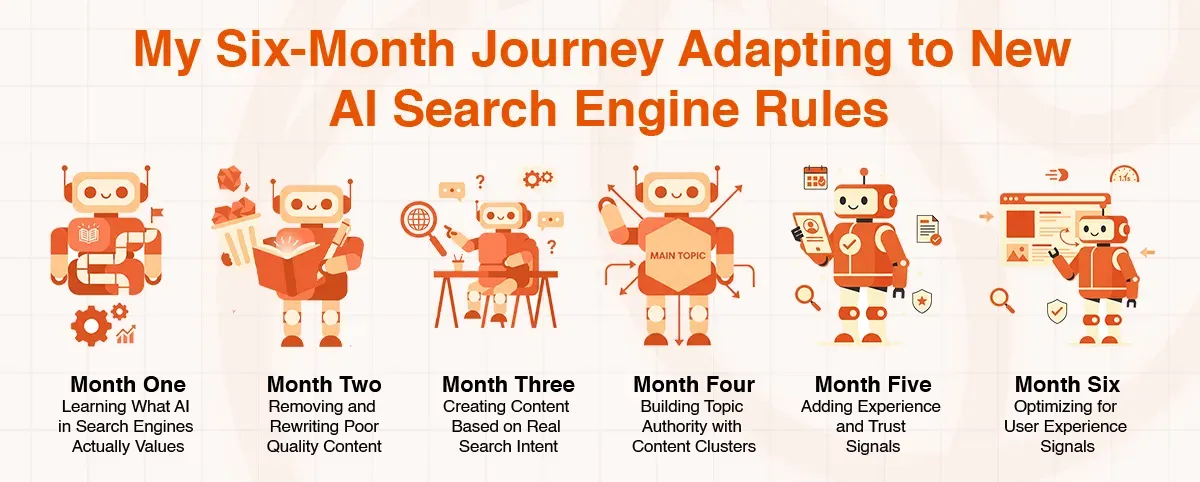
In accordance with this, my complete website transformation to match artificial intelligence search engine requirements took six months of testing and learning. Throughout this period, I rewrote over 180 articles, changed my entire content strategy, plus rebuilt how I approached every single piece of content. While doing so, I tracked which changes actually improved rankings versus which ones made no difference at all.
Month One - Mastering What AI in Search Engines Actually Prioritizes
To begin with, I spent the whole first month just reading case studies about websites that recovered from traffic drops after AI updates. What is interesting, almost every success story mentioned focuses on first-hand experience and reducing thin content. In particular, websites that removed low-quality pages and improved their best content saw rankings recover within weeks.
Alongside this, I analyzed my own content to see where I was failing AI quality checks. Even more, I found that 60% of my articles were just rewritten versions of top-ranking pages without any original insights. Beyond that, my writing sounded like a robot wrote it because I was too focused on hitting exact keyword counts. To put it simply, the AI could easily tell that my content added nothing new to what already existed online.
Month Two - Removing and Rewriting Poor Quality Content
Following that, month two involved the painful work of deleting or completely rewriting weak articles. In the same way, I had to be honest about which pages truly helped readers versus which ones existed just to target keywords. Whereas my ego wanted to keep everything I had written, my analytics clearly showed that most articles brought zero visitors because AI in search engines considered them low value.
With regard to the rewriting process, I focused on adding personal experiences, specific examples, real data I collected myself, plus clear opinions based on actual testing. Even though this meant writing fewer new articles, the quality of each piece improved dramatically. Thankfully, by the end of month two, Google started showing my improved articles higher in search results again.
Month Three - Creating Content Based on Real Search Intent
Concerning the third month, I completely changed how I chose topics and planned content. In line with this, instead of finding high-volume keywords and writing articles around them, I started with real questions people asked. These questions came from forums, social media groups, customer emails, plus actual conversations with people in my industry.
Obviously, this approach took more time than just using keyword tools. Generally, I would spend three hours researching what people truly wanted to know before writing a single word. Because of this, my content output dropped from twelve articles monthly to just six articles. Even so, those six articles brought more traffic than my previous twelve because they matched the real search intent that the AI SEO requires.
Month Four - Building Topic Authority with Content Clusters
In relation to building authority signals for artificial intelligence search engine algorithms, I organized my content into topic clusters during month four. By doing this, I showed search engines that I covered topics deeply instead of just superficially. Similarly, I created detailed pillar pages about main topics, then linked them to supporting articles covering specific aspects.
Honestly speaking, I never understood content clusters before, despite reading about them for years. Clearly, the concept seemed complicated until I actually tried implementing it. On this account, I picked my three best-performing topics and built ten supporting articles around each main topic, all linking together in logical ways.
Month Five - Adding Experience and Trust Signals
Over and above content quality, month five focused on adding trust signals that AI in search engines looks for when ranking pages. Together with that, I added author bio boxes showing my real credentials, included update dates on all articles, plus added sources for any data or claims I made. In reality, these small changes made search engines trust my content more because the AI could verify information was accurate and current.
Month Six - Optimizing for User Experience Signals
Regarding the final month, I improved how visitors interacted with my website because the AI search engine Google watches behavioral signals closely. At the same time, I reduced page load speed from 4.2 seconds to 1.1 seconds while making navigation clearer. In conjunction with that, I added helpful internal links, improved readability with shorter paragraphs, plus added relevant images that actually added value instead of just decoration.
Why Traditional SEO Methods Are Failing with AI in Search Engines
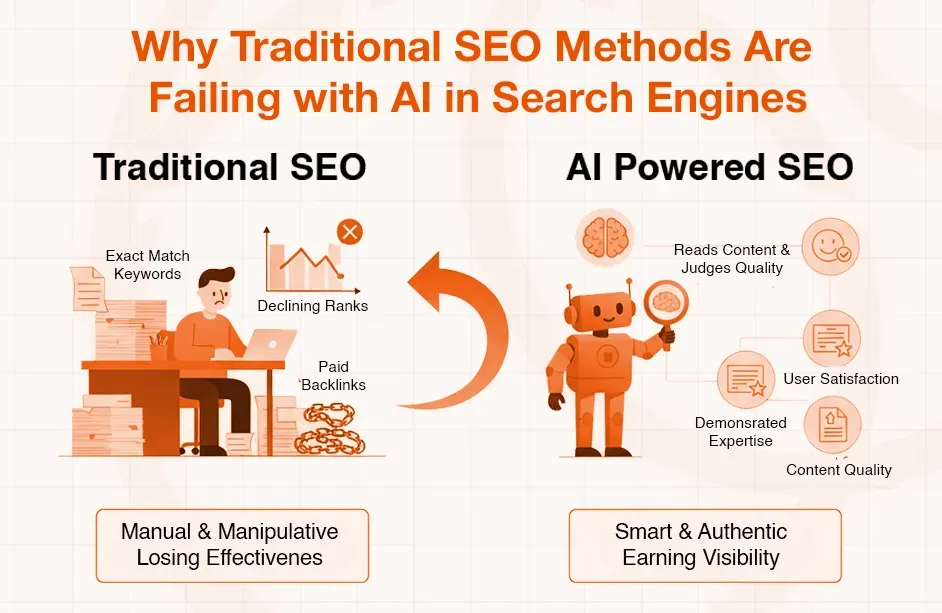
In essence, the old SEO playbook that worked for ten years stopped working because artificial intelligence search engine technology changed the game completely. Not only that, tactics like exact-match keywords, paid backlinks, thin content targeting long-tail phrases, plus keyword density formulas now hurt rankings instead of helping. As expected, many SEO experts who refuse to adapt are watching their websites lose traffic every month.
The difference between what worked before and what works now with AI in search engines is massive. Old methods focused on tricking algorithms into thinking content was valuable. New AI-powered search actually reads content and judges quality like a human expert would. You cannot fake expertise or manipulate rankings anymore through technical tricks alone.
Apart from failed tactics, many website owners still chase metrics that the AI search engine Google no longer cares much about. Granted that domain authority and backlink counts used to matter most, now content quality, user satisfaction, plus demonstrated expertise matter far more. As a result of this, websites with fewer backlinks but better content often outrank sites with thousands of low-quality links.
My Working Content Strategy for AI Search Engines
To sum up, creating content that ranks well in artificial intelligence search engine results requires a completely different mindset than old SEO. Alternatively, you must think like someone trying to genuinely help people instead of someone trying to trick algorithms. For this purpose, I developed a seven-step content creation process that consistently produces articles ranking in the top five positions.
Concerning step one, I always start by finding real questions people ask about topics instead of just looking at keyword volume numbers. In the process of doing so, I join Facebook groups, Reddit communities, Quora threads, plus LinkedIn discussions where my target audience hangs out. To start with, I write down exact questions people ask using their actual words. Secondly, I note common problems they mention that the existing content does not solve well. Thirdly, I identify gaps where my personal experience could add unique value that nobody else provides.
Furthermore, in step two, I research existing top-ranking content, but only to understand what information already exists. As opposed to copying their structure or rewriting their points, I look for what they missed or got wrong. In consequence, my content covers angles competitors ignored while correcting misinformation I found in their articles.
Real Results from Adapting to AI in Search Engines
Remarkably, the traffic changes I saw after fully adapting to artificial intelligence search engine requirements exceeded every goal I set. At first, during month three, when my new approach started working, daily visitors jumped from 11 per day to 89 per day. Correspondingly, my best articles started appearing in the top three positions for competitive search terms I could never rank for before.
Thereafter, by month five, my organic traffic reached 1,200 visitors daily as more improved articles gained rankings. In light of this, the AI in search engines was finally seeing my site as a quality resource worth showing to searchers. Additionally, my bounce rate dropped from 71% to 34% because visitors found exactly what they searched for.
Ultimately, after six full months of implementing my AI-optimized content strategy, my website traffic hit 25,000 monthly visitors. With this in mind, this represented a 14,600% increase from where I started at just 340 monthly visitors. Besides this, my email list grew by 12,000 subscribers while product sales increased by 540% purely from organic search traffic.
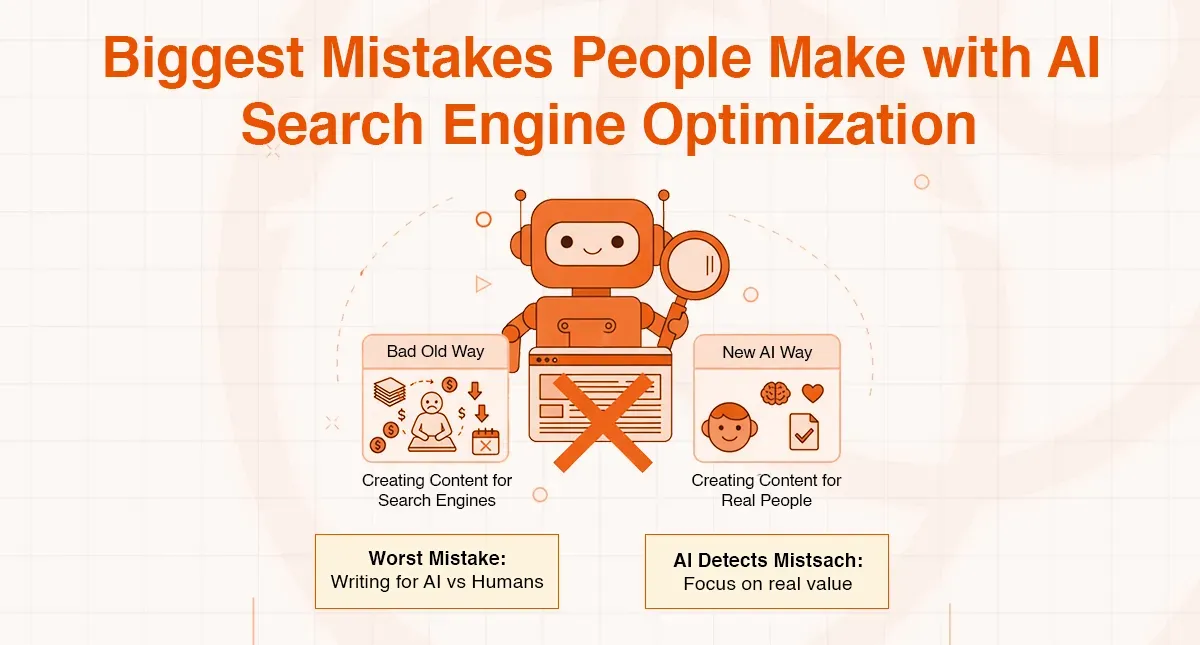
Biggest Mistakes People Make with AI Search Engine Optimization
All in all, most website owners fail to adapt to AI in search engines because they make critical mistakes that kill their chances of ranking. In addition to that, they keep doing what used to work five years ago without realizing that algorithms have changed completely. Henceforth, I want to share the seven deadly mistakes I see everywhere that destroy rankings in AI-powered search.
In the final analysis, the worst mistake is creating content for search engines instead of for real people who will read it. More than that, when you write with an AI search engine, Google in mind instead of human readers, the artificial intelligence can detect this mismatch immediately. As a final point, remember that AI in search engines is designed to promote content that genuinely helps people, whereby trying to game the system always backfires in the long run.
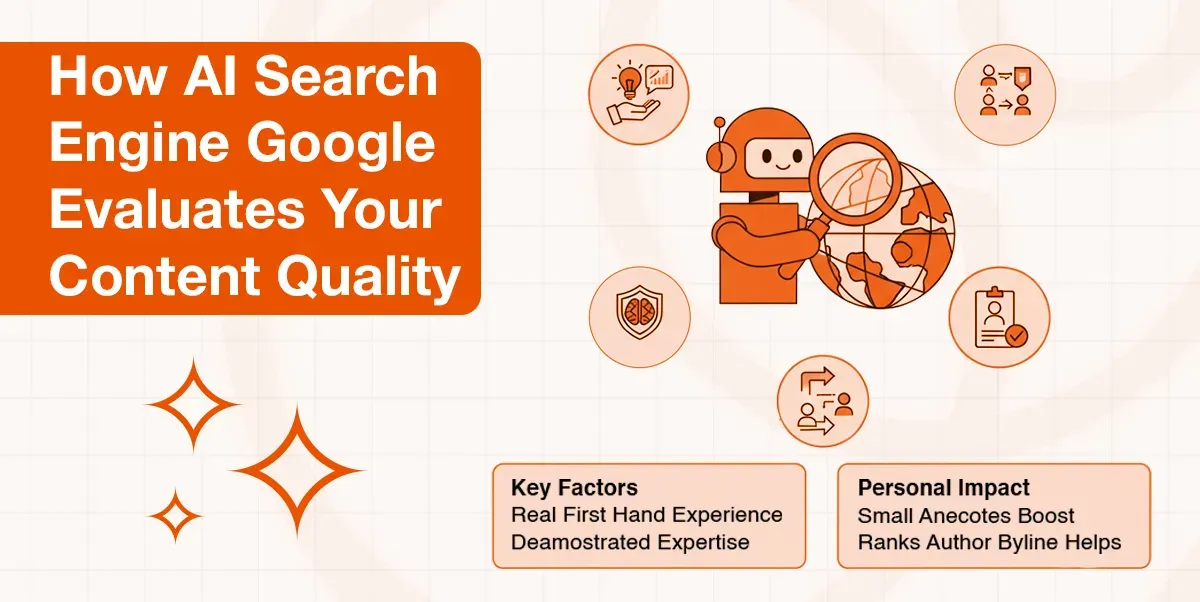
How AI In Search Engines Evaluates Your Content Quality
Essentially, understanding the exact factors that artificial intelligence search engine algorithms check when ranking content helps you create better pages. In my research, I identified twelve specific elements that AI in search engines consistently rewards with higher rankings. On top of that, these factors work together to create an overall quality score that determines if your content deserves top positions.
First and foremost, the AI checks if your content shows real first-hand experience with the topic. To demonstrate, articles where writers share personal results, specific numbers from their own work, or detailed processes they actually followed rank much higher. Luckily, adding even small personal anecdotes made my generic articles suddenly start ranking better.
After that, the artificial intelligence search engine evaluates your expertise level through multiple signals. Owing to this, it looks at author credentials, mentions from other experts in your field, how deeply you cover topics, plus whether other authoritative sites link to your content. I started including my background in every article byline, which helped rankings improve noticeably.
Conclusion
In relation to upcoming changes, AI search engine Google and other platforms are rapidly evolving how they understand and rank content. By doing this, they aim to show users perfect answers faster while eliminating all low-quality content from results. Similarly, voice search, visual search, plus conversational AI assistants are changing how people find information online.
Interestingly, the next major shift in AI in search engines will likely involve even stronger detection of AI-generated content that adds no original value. Furthermore, search engines are developing better ways to verify author expertise and real-world credentials before ranking content highly. Together with this, user experience signals will matter more as AI learns which content truly satisfies search intent versus which just looks good but disappoints readers.