Text reads 'Claude vs ChatGPT: The Ultimate AI Tools Showdown' with logos for both.
Tools ComparisonPosted on Apr 11, 20264 min read

Claude vs ChatGPT: The Ultimate AI Tools Showdown

Written by :Hareem Khan

TL;DR

Claude and ChatGPT are two of the most advanced AI platforms available today, each excelling in different areas. ChatGPT stands out for its creativity, flexibility, SEO content generation, and strong ecosystem of plugins and automation tools. Claude, on the other hand, is known for its accuracy, long-form reasoning, and ability to process very large documents with strong safety guardrails. While ChatGPT is ideal for marketing, coding, and rapid ideation, Claude performs better for research-heavy tasks and structured analysis.

Claude and ChatGPT are undoubtedly the leading AI platforms in today’s fast-paced digital world. While GPT could rightfully be named the pioneer of AI writing/research tools, Claude has made a name for itself with its top-notch features and impressive performance. In recent times, AI-based marketing tools have been growing at an exponential pace, but a majority of these platforms are based on the same AI engine as ChatGPT and Claude.

Some apps, like SAAGA Solve, allow you to work with the AI tool of your choice. To select the right tool, it’s crucial to delve into the Claude vs ChatGPT discussion.
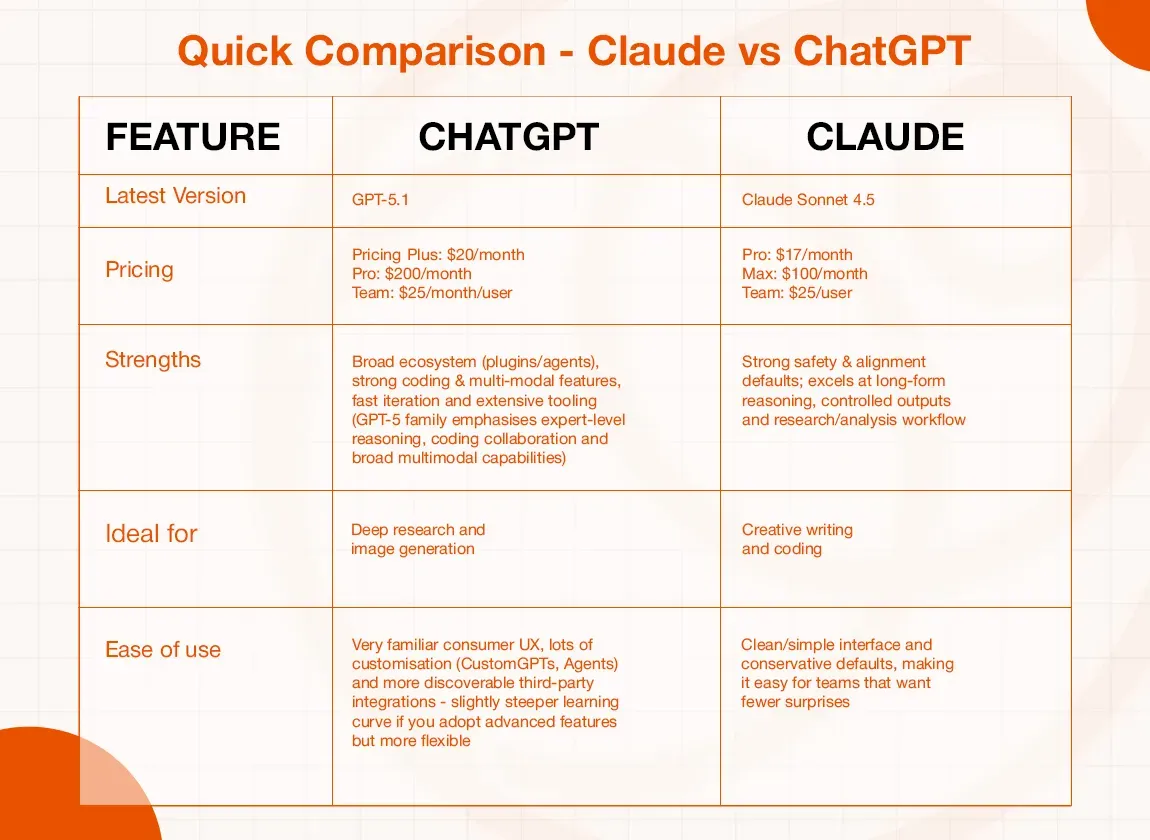
Table comparing features, pricing, strengths, and ideal use cases for ChatGPT and Claude.

Quick Comparison - Claude vs ChatGPT

Let’s take a look at how both leading AI models stack up in terms of performance, pricing, strengths, and usability:

FEATURE

CHATGPT

CLAUDE

Latest Version

GPT-5.1

Claude Sonnet 4.5

Pricing

Plus: $20/month

Pro: $200/month

Team: $25/month/user

Pro: $17/month

Max: $100/month

Team: $25/user
Strengths

Broad ecosystem (plugins/agents), strong coding & multi-modal features, fast iteration and extensive tooling (GPT-5 family emphasises expert-level reasoning, coding collaboration and broad multimodal capabilities).

Strong safety & alignment defaults; excels at long-form reasoning, controlled outputs and research/analysis workflow

Ideal for

Deep research and image generation

Creative writing and coding

Ease of use

Very familiar consumer UX, lots of customisation (CustomGPTs, Agents), and more discoverable third-party integrations - slightly steeper learning curve if you adopt advanced features, but more flexible.

Clean/simple interface and conservative defaults, making it easy for teams that want fewer surprises

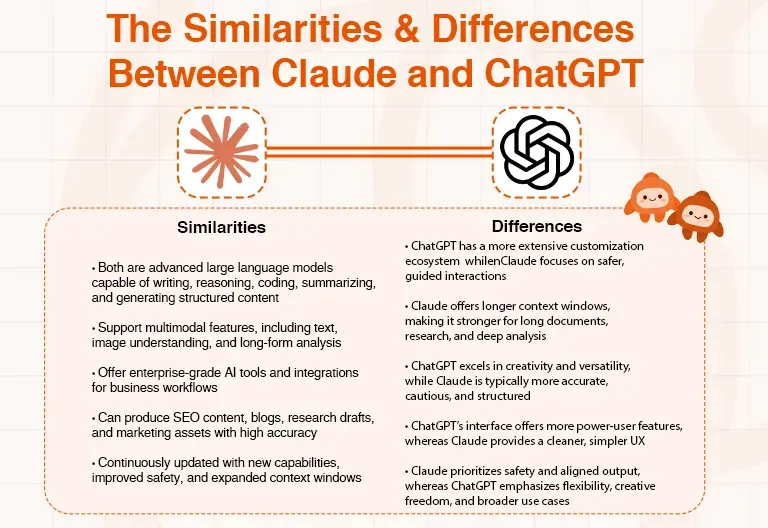
Infographic comparing similarities and differences between AI models Claude and ChatGPT.

The Similarities & Differences Between Claude and ChatGPT

How similar and different are Claude and ChatGPT? Let’s see the specifics;

Similarities

  • Both are advanced large language models capable of writing, reasoning, coding, summarizing, and generating structured content.
  • Support multimodal features, including text, image understanding, and long-form analysis.
  • Offer enterprise-grade AI tools and integrations for business workflows.
  • Can produce SEO content, blogs, research drafts, and marketing assets with high accuracy.
  • Continuously updated with new capabilities, improved safety, and expanded context windows.

Differences

  • ChatGPT has a more extensive customization ecosystem (Custom GPTs, agents, plugins), while Claude focuses on safer, guided interactions.
  • Claude offers longer context windows, making it stronger for long documents, research, and deep analysis.
  • ChatGPT excels in creativity and versatility, while Claude is typically more accurate, cautious, and structured.
  • ChatGPT’s interface offers more power-user features, whereas Claude provides a cleaner, simpler UX.
  • Claude prioritizes safety and aligned output, whereas ChatGPT emphasizes flexibility, creative freedom, and broader use cases.
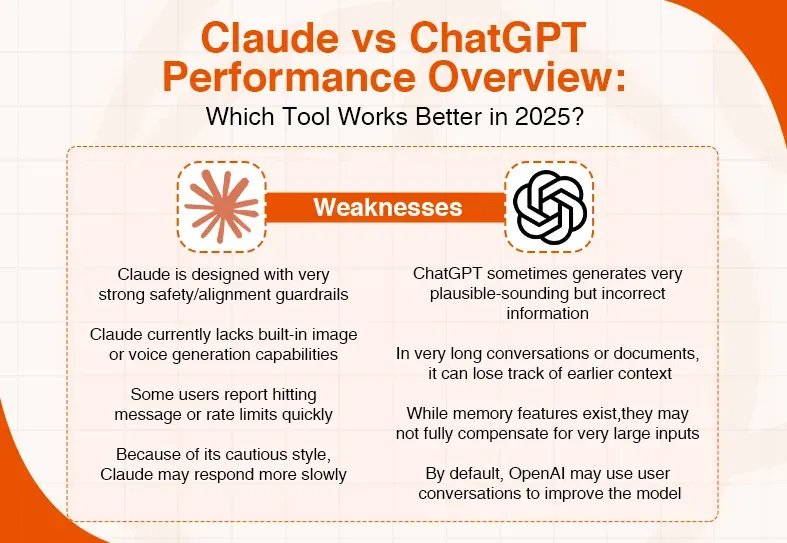
A comparison chart highlighting the weaknesses of Claude and ChatGPT AI models.

Claude vs ChatGPT Performance Overview: Which Tool Works Better?

With AI continuing to dominate the world of content creation and digital marketing in 2025, choosing the right model can significantly affect productivity, output quality, and cost-efficiency. Here’s a breakdown of how Claude and ChatGPT perform across the most critical dimensions that matter for modern teams.

Strengths

ChatGPT:

  • Tops in SEO-friendly, creative, high-engagement content. It writes faster and adapts easily to brand tone, making it ideal for blogs, landing pages, and marketing campaigns.
  • Offers strong context retention as well, especially in GPT-5, but it’s more optimised for interactive, rapid-response tasks.
  • Provides unmatched flexibility with plugins, agents, and a massive ecosystem - ideal for marketers, developers, and automation teams building AI-powered workflows.
  • Offers affordable tiers for individuals and powerful Pro options for teams scaling high-volume content.

Claude:

  • Excels at long-form reasoning and precise, research-backed writing. If you work with reports, guides, or data-heavy content, its accuracy and stability deliver consistent results.
  • Leads when it comes to understanding and processing long documents, making it perfect for multi-step workflows and deep analysis.
  • Provides a clean, controlled experience built for reliability.
  • Cost-efficient for long-context and accuracy-driven tasks.

Weaknesses

ChatGPT:

  • ChatGPT sometimes generates very plausible-sounding but incorrect information
  • In very long conversations or documents, one can lose track of earlier context, leading to inconsistency.
  • While memory features exist, they may not fully compensate for very large inputs or deeply nested contexts.
  • By default, OpenAI may use user conversations to improve the model.

Claude:

  • Claude is designed with very strong safety/alignment guardrails, which can make it refuse or overly restrict responses even for harmless or creative prompts.
  • Claude currently lacks built-in image or voice generation capabilities.
  • Some users report hitting message or rate limits quickly, especially in more active or heavy-usage workflows.
  • Because of its cautious style, Claude may respond more slowly.

Choose Claude for: accuracy, enterprise stability, long-form reasoning, and safe outputs.
Choose ChatGPT for: speed, creativity, SEO content, development work, and workflow automation.

With SAAGA Solve’s SEO Suite, you can integrate either model into your content, SEO, and automation pipeline for maximum impact.
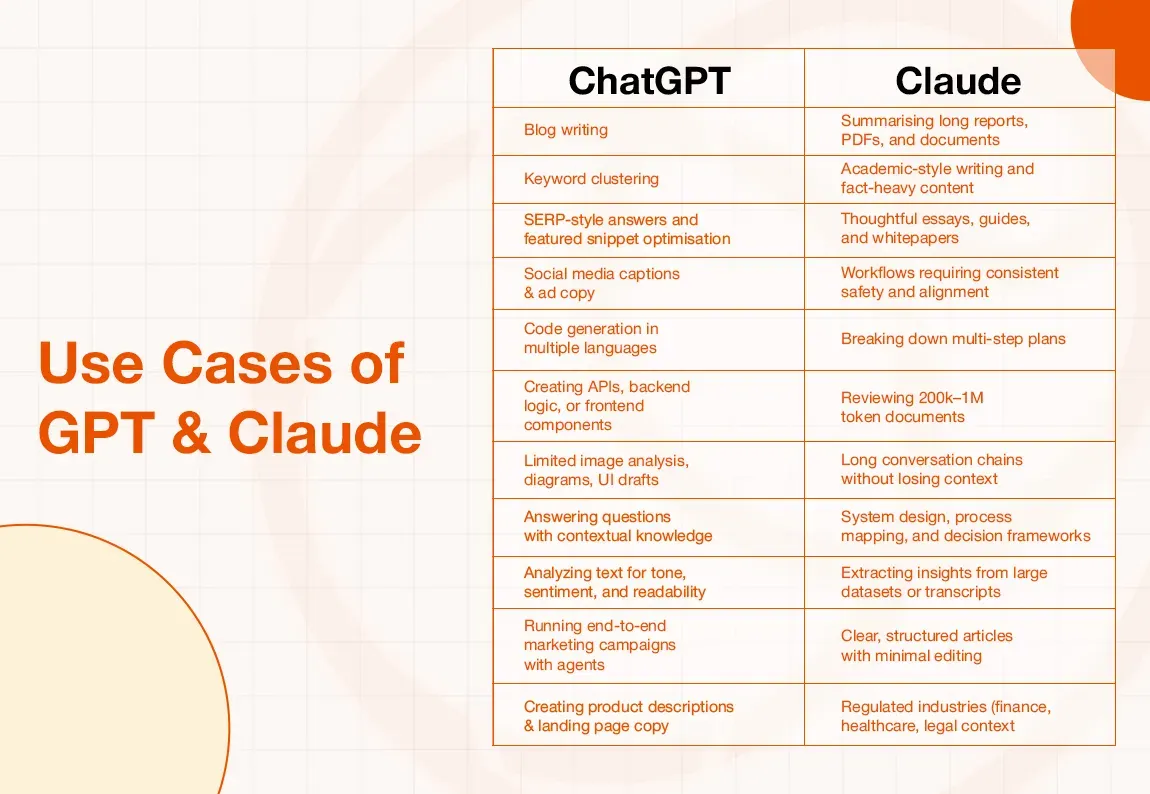
Table comparing use cases and capabilities of ChatGPT and Claude, showing strengths in different areas.

Use Cases of GPT & Claude

Curious what these AI tools can actually do? Let’s break it down.

ChatGPT

Claude

Blog writing

Summarising long reports, PDFs, and documents

Keyword clustering

Academic-style writing and fact-heavy content

SERP-style answers and featured snippet optimisation

Thoughtful essays, guides, and whitepapers

Social media captions & ad copy

Workflows requiring consistent safety and alignment

Code generation in multiple languages

Breaking down multi-step plans

Creating APIs, backend logic, or frontend components

Reviewing 200k–1M token documents

Limited image analysis, diagrams, UI drafts

Long conversation chains without losing context

Answering questions with contextual knowledge

System design, process mapping, and decision frameworks

Analyzing text for sentiment, tone, or readability

Extracting insights from large datasets or transcripts

Running end-to-end marketing campaigns with agents

Clear, structured articles with minimal editing

Creating product descriptions & landing page copy

Regulated industries (finance, healthcare, legal context)

Real-World Scenarios

A content team uses Anthropic’s Claude to analyze long research reports and produce detailed article drafts, while ChatGPT helps brainstorm headlines, generate social media captions, and create quick marketing copy.

A consulting firm relies on Claude to summarize lengthy PDFs, policy documents, and meeting transcripts with high accuracy, while ChatGPT assists the team in explaining complex ideas to clients and drafting presentations.

A startup product team uses ChatGPT for rapid ideation, UX copy, and customer-facing FAQs, while Claude reviews long documentation, refines messaging, and ensures the final content maintains clarity and consistency.

Running a comparison test between GPT and Claude

Let’s see how efficiently these tools perform when given the same prompt.

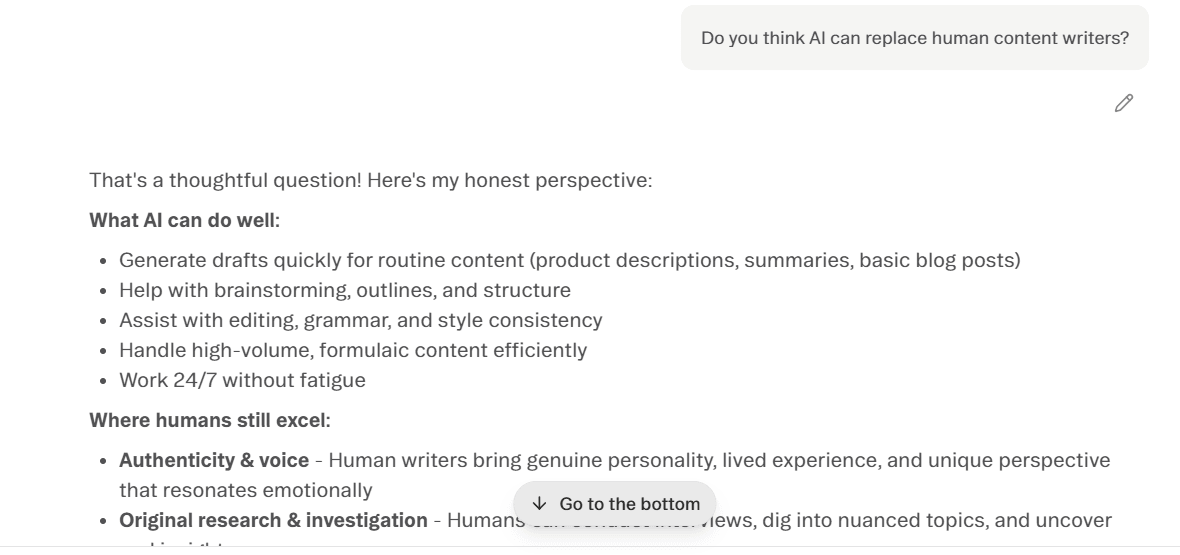
Prompt # 1: Do you think AI can replace human content writers?

ChatGPT’s response:
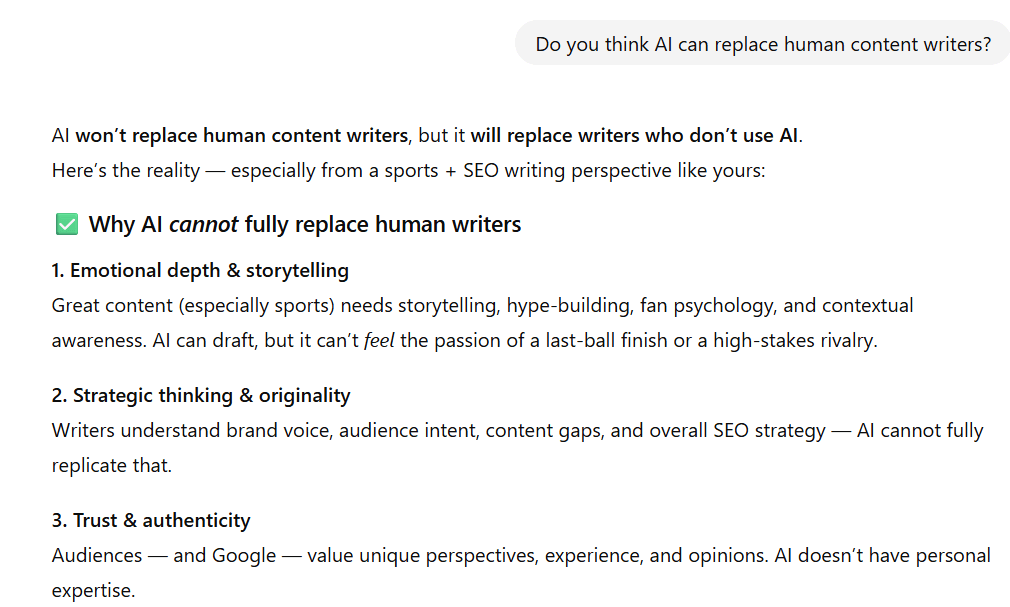
A document titled 'Why AI cannot fully replace human writers' lists three key reasons.

Claude’s response:

AI chat discusses capabilities of AI versus human strengths in content writing roles.

Both tools agree that AI cannot replace human content writers and highlight similar reasons why human oversight remains essential. This reinforces that there is no definitive winner in the Claude vs ChatGPT comparison; each excels in its own way, and both operate with broadly similar capabilities.

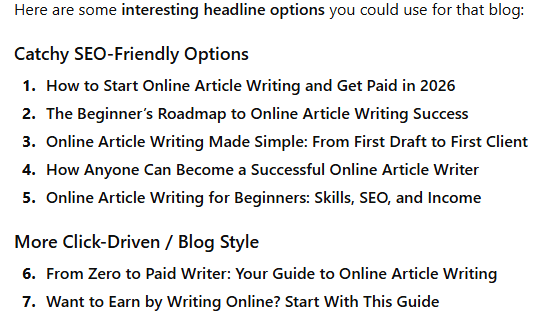
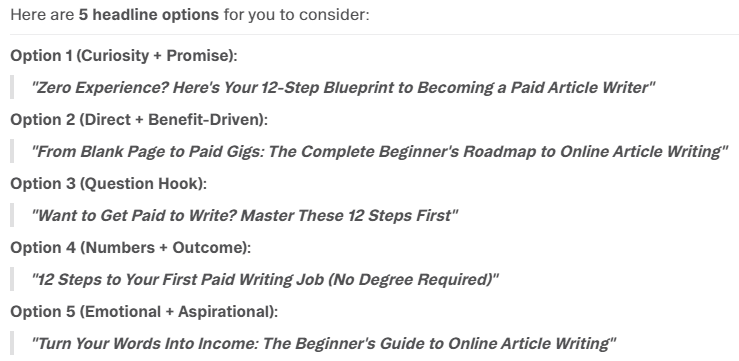
Prompt # 2: Can you generate an interesting headline for the following blog?

https://saagasolve.com/blog/online-article-writing

ChatGPT’s response:

A list of catchy and click-driven headline options for online article writing blogs.

Claude’s response:

List of five headline options for article writing, categorized by their persuasive style.

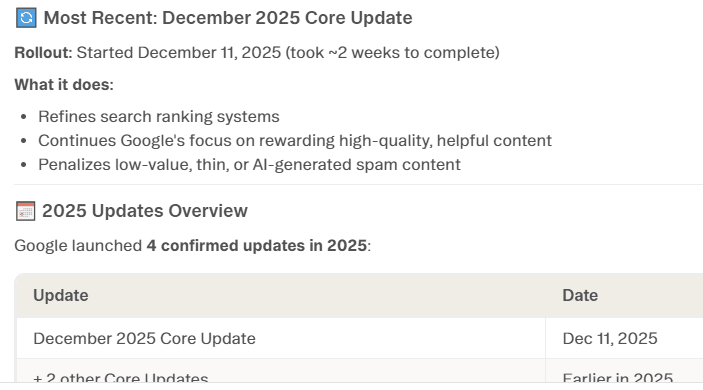
Prompt #3: Do you know about Google’s latest algorithm update?

ChatGPT:
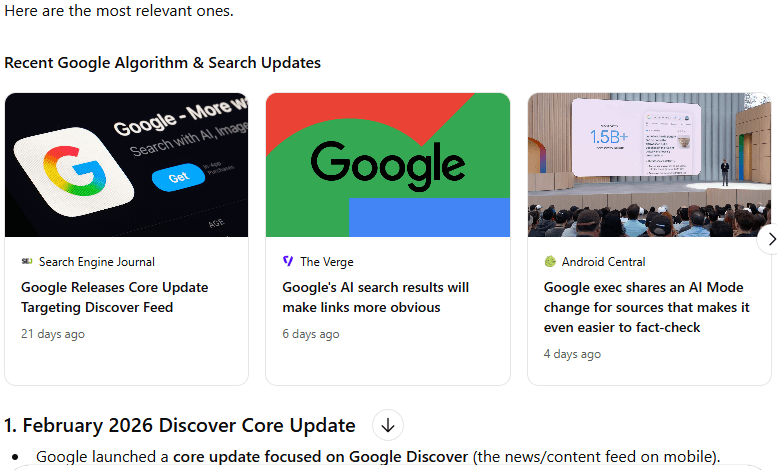
Google logo and text 'Search with AI' for a core update news article.

Claude:

Summary of Google's December 2025 Core Update, detailing rollout date and impact on search rankings.

With reference to the last prompt, GPT has more recent knowledge, whereas Claude is lagging in terms of updating its information base. This difference becomes noticeable when discussing the latest industry trends, algorithm updates, or newly released technologies.
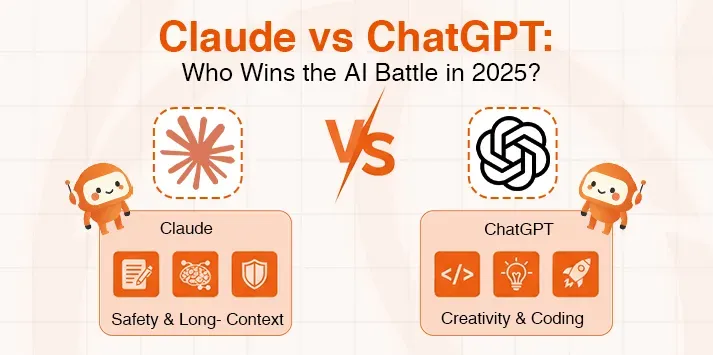
Infographic comparing Claude and ChatGPT's strengths, asking 'Who Wins the AI Battle in 2025?'

Claude vs ChatGPT: Who Wins the AI Battle?

Both Claude and ChatGPT are top-of-the-line AI tools that continue to evolve. There is hardly any performance disparity between the two, but their use cases differ quite a lot.
Frequently Asked Questions

In 2026, Claude 4 is widely considered the gold standard for long-form, research-heavy, and high-nuance content due to its superior reasoning and 'human-like' writing style. ChatGPT (GPT-5) excels at creative brainstorming, high-velocity SEO production, and multi-modal tasks like generating images or analyzing complex datasets to find content trends.


Yes! Leading platforms like SAAGA Solve allow you to orchestrate workflows that use both. For example, you can use ChatGPT to perform rapid keyword research and clustering, then pass those requirements to Claude to write a deeply researched, empathetic article that avoids the 'AI-sounding' tropes.


Claude remains the leader in 'Constitutional AI' and safety-first principles, making it the preferred choice for legal, medical, or highly regulated industries in 2026. Its outputs are generally more predictable and less prone to 'hallucinations' when processing sensitive enterprise data compared to more creative-leaning models.


Absolutely. While both generate metadata, ChatGPT's integration with real-time search data makes it slightly faster for trending keyword alignment. However, using SAAGA Solve simplifies this by automating the generation of schema markup, meta descriptions, and internal linking suggestions across both models simultaneously.


Yes. In 2026, SAAGA Solve functions as an AI 'Work Operating System' where teams can share prompts, review AI-drafted outputs, and maintain a consistent brand voice across all Claude and ChatGPT workflows. This eliminates the 'silo effect' of individual employees using different personal AI accounts.


No. The platform is designed with a 'No-Code' philosophy. Marketers, writers, and business owners can use pre-built 'Agentic' templates to run complex multi-step marketing projects just by providing a basic description of their goals.


Yes. Claude’s massive context window (supporting up to 500k+ tokens in 2026) allows SAAGA Solve to process entire books or technical manuals in one go. Meanwhile, ChatGPT’s advanced 'Reasoning' mode handles the step-by-step logic required for complex project management and coding tasks.


Claude 4 is the current 2026 favorite for long-form content because it maintains narrative consistency over tens of thousands of words without repetitive phrasing. ChatGPT is excellent for structured 'listicles' or modular content where each section needs a very specific creative flair or stylistic hook.


Both are highly accurate, but Claude 4 tends to follow 'Negative Constraints' better (e.g., 'Do not use these 10 words'). ChatGPT (GPT-5) is often more accurate for technical 'How-to' guides, mathematical reasoning, and interpreting real-time web data to provide the most current facts.


For 2026, ChatGPT Plus remains the best value for general-purpose, high-frequency tasks ($20/mo). Claude’s professional tiers are often better for heavy researchers who need to process massive documents daily. Using an aggregator like SAAGA Solve is typically the most cost-effective for businesses, as it provides access to both models under a single enterprise-grade subscription.

    Claude vs ChatGPT | Features, Performance, and Use Cases