7 Best Marketing Analytics Tools for Data-Driven Growth
TL;DR
The article discusses 7 key marketing analytics tools and marketing analytics platforms, such as GA4, Semrush, HubSpot, and Hotjar, which allow businesses to use raw data to generate practical insights. These tools are divided into the main focus (web, SEO, user behavior, social, and BI) and are essential for the optimization of campaigns, ROI, and the overall enhancement of your strategy of marketing analytics on your webpage. In order to push data-driven growth, the right mix of these best marketing analytics tools is the decision to make.
Precise decisions are the key aspect of successful AI-powered marketing in the present data-driven age, which are no longer speculative. An effective digital strategy is built on a core set of marketing analytics tools and advanced marketing analytics platforms.
These core resources are meant to turn raw data into practical insights so that marketers can measure performance accurately, optimize campaigns, and verify ROI. In order to maximize your strategy effectively, it is important to apply the most efficient marketing analytics tools.
The Use of Marketing Analytics Tools
Marketing analytics tools are software applications that have been specifically installed to collect, process, and visualize data in all marketing touchpoints, such as web, social, email, and paid touchpoints. The question platforms of these marketing analytics solutions provide answers to major strategic questions in the form of: What are the most profitable channels, How do visitors behave on the site, and What content drives leads efficiently?
Through these strong marketing analytics tools, organizations have the ability to move out of reactive changes to proactive, productive, and data-driven decision-making.
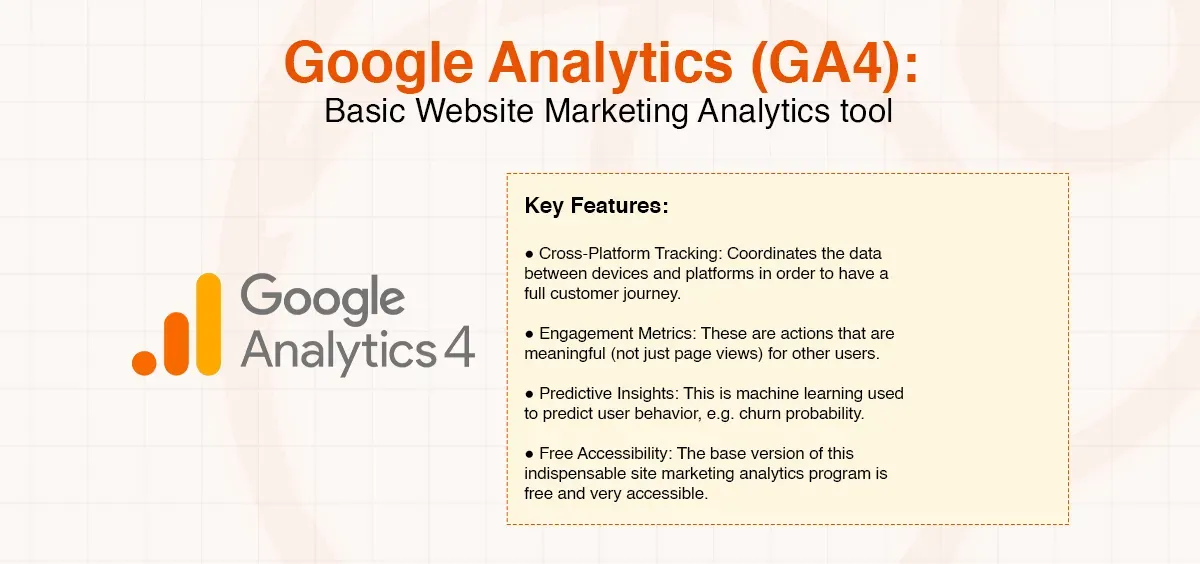
Google Analytics (GA4): Basic Website Marketing Analytics tool
Google Analytics (GA4) is the standard in the market of website marketing analytics. GA4 relies on an event-based framework to monitor cross-site user behavior on web and mobile applications to provide a user-centric view that is holistic in nature.
Key Features:
- Cross-Platform Tracking: Coordinates the data between devices and platforms in order to have a full customer journey.
- Engagement Metrics: These are actions that are meaningful (not just page views) for other users.
- Predictive Insights: This is machine learning used to predict user behavior, e.g., churn probability.
- Free Accessibility: The base version of this indispensable site marketing analytics program is free and very accessible.
Google Analytics is the most useful in measuring traffic, audience, and conversion tasks; it is among the most appropriate marketing analytics tools in terms of basic tracking.
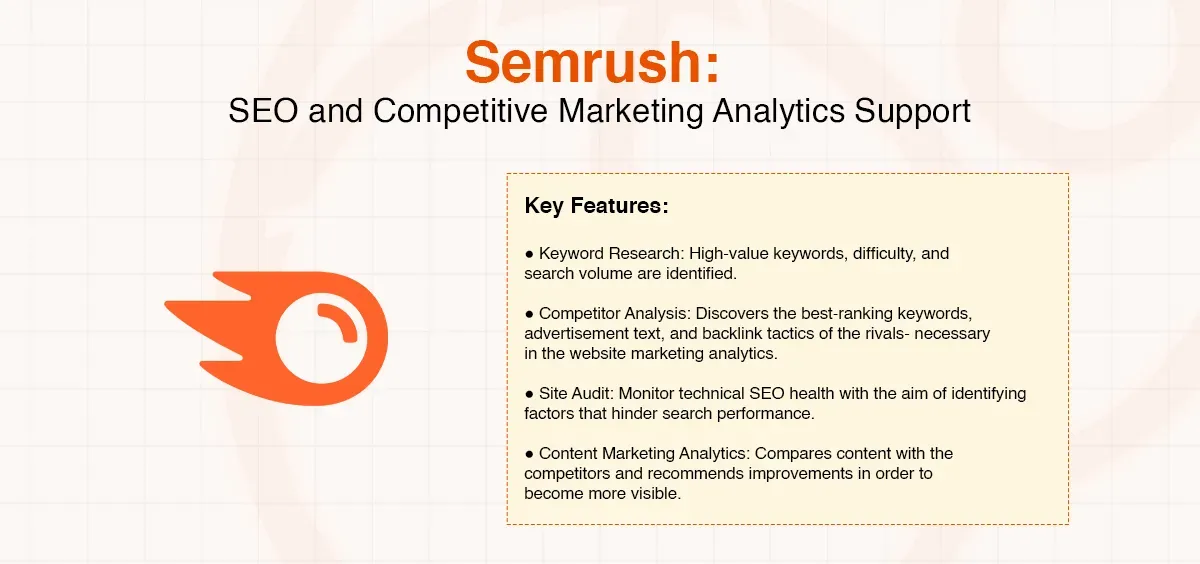
Semrush: SEO and Competitive Marketing Analytics Support
Along with Google Analytics, Semrush can add vital external competitive insights, which validate its position as one of the most effective marketing analytics tools. It is a combination of marketing analytics and is concerned with search engine optimization, content, and competition analysis.
Key Features:
- Keyword Research: High-value keywords, difficulty, and search volume are identified.
- Competitor Analysis: Discovers the best-ranking keywords, advertisement text, and backlink tactics of the rivals- necessary in the website marketing analytics.
- Site Audit: Monitor technical SEO health with the aim of identifying factors that hinder search performance.
- Content Marketing Analytics: Compares content with the competitors and recommends improvements in order to become more visible.
Any organization that values organic search and demands its marketing analytics tools to provide in-depth competitive intelligence always uses Semrush.
HubSpot: The All-in-One Inbound Marketing Analytics
HubSpot is an all-encompassing marketing analytics tool that integrates analytics into its CRM and inbound package. The integration renders it one of the most effective marketing analytics applications with respect to end-to-end lead management and funnel tracking.
Key Features:
- Integrated CRM: Enables the concept of closed-loop reporting, which ties marketing processes to the sales results and revenue.
- Lead Attribution: Follows all of the marketing touchpoints that contribute to lead creation and conversion.
- Website Marketing Analytics: Offers single reporting, which covers traffic, source performance, and conversion paths.
- Email Marketing Analytics: measures the interaction and the profits that email communications have produced.
The HubSpot marketing analytics is holistic; it is necessary to get the marketing and sales teams on the same page.
Hotjar: User Behavior and Visual Website Marketing Analytics Tool
Hotjar is a major specialized marketing analytics tool in order to gain insight into the reasons behind the actions of users. It gives an appearance and actions of relationships, the ideal complement of quantitative web marketing analysis tools such as Google Analytics.
Key Features:
- Heatmaps: This is a visual representation of the user clicks, scrolls, and movement on a page.
- Session Recording: This feature enables one to playback actual user sessions to identify areas of friction and usability problems.
- Conversion Funnels: Visualizes the conversion funnel, showing specific areas where the conversion drops off to be optimized now.
- Surveys & Feedback: Gathers useful qualitative information directly from site visitors.
Hotjar offers the contextual “why”, which is why it is one of the best marketing analytics tools to optimize the conversion rate.
Mixpanel: The Marketing Analytics Platform of Products
Compared to the generic marketing analytics tools, Mixpanel prioritizes product analytics- user interaction in a digital product or application. It is among the finest marketing analytics software for SaaS and product-based companies.
Key Features:
- Event-Based Tracking: Monitors all granular user actions (events) to gauge feature usage and adoption rates.
- Cohort Analysis: Team users to follow retention and behavior patterns with respect to certain time periods.
- Segmentation: Allows the profound examination of the target users depending on their activities or channel of origin.
In companies engaged in activation and retention KPIs, Mixpanel provides an in-depth level that cannot be found on general marketing analytics applications.
Sprout Social: The Social Media Marketing Analytics tool
Due to the significance of social channels, a specific marketing analytics tool is required. Sprout Social is an all-inclusive marketing analytics tool that comprises social media publishing, listening, and powerful analytics.
Key Features:
- Cross-Channel Reporting: Unites the performance metrics (engagement, reach, growth) of all key social networks.
- Competitive Analysis: Compares your performance socially with the major competitors.
- Social Listening: Tracks brand mentions and sentiment in order to know what is happening in real-time and manage a crisis.
- Integrated Paid Social: Integrates reporting to determine the proper ROI of organic and paid social work.
Sprout Social makes social media work add tangible business value, and this is why it is an essential component of your entire set of marketing analytics tools.
Tableau: The Analytics Marketing Data Visualization Tool
The aggregation and visualization layer is Tableau (or any other BI platform). It is linked to all your other specialized marketing analytics and turns intricate data into dynamic and interactive dashboards, commonly regarded as one of the finest marketing analytics tools to use in executive reporting.
Key Features:
- Aggregation of Data: Easily unites with almost any data source, beyond just GA4, CRM data, and other marketing analytics tools.
- Interactive Visualizations: Develops interactive dashboards that enable the stakeholders to browse the data trends visually.
- Custom Reporting: Allows extremely customized reports to be created on a unit-by-unit or executive summary basis.
In the case of organizations dealing with large and intricate data comprising of various marketing analytics systems, Tableau can deliver the much-needed visualization layer to facilitate easy executive decision-making.
Conclusion
The selection of the most appropriate marketing analytics tools will mean matching their features with your strategic business objectives. An analytics stack that is performing at a high level is usually a combination of a core website marketing analytics tool with specialized marketing analytics platforms such as SEO, social media, and user experience.
With the strategic use of these key marketing analytics tools, your team will be in a better position to better spend, run smarter campaigns, and create business growth that is verifiable and supported with data.