The second generation of AI is powered by AI agents: autonomous systems capable of reasoning, planning, using tools, and taking multi-step actions to achieve high-level goals. Unlike chatbots, these systems possess true agency. Companies developing AI agents are prioritizing autonomy, safety (e.g., Anthropic), and scalable orchestration (e.g., OpenAI API), signaling a fundamental shift in the quality of automation.
The future of Artificial Intelligence (AI) is taking shape at a very fast pace, and it is no longer about automation only, but also the advanced, self-directing systems called AI agents. These electronic beings are a major part of AI-based digital marketing and can sense the world around them, make judgments, and give multi-faceted and multi-stage judgments in order to reach a set objective with very little human intervention in many cases. They are the future of smart automation as they will transform productivity and innovation in all fields.
The key difference between a real AI agent and a chatbot is its autonomy and agency. In contrast to the conventional chatbots or basic scripts, a high-quality top AI agent is able to reason, plan, learn, and apply the tools to perform complex tasks, occasionally taking days or weeks. This higher tier of operation is the reason why the demand for skilled AI agent developers and top AI agent list solutions is soaring.
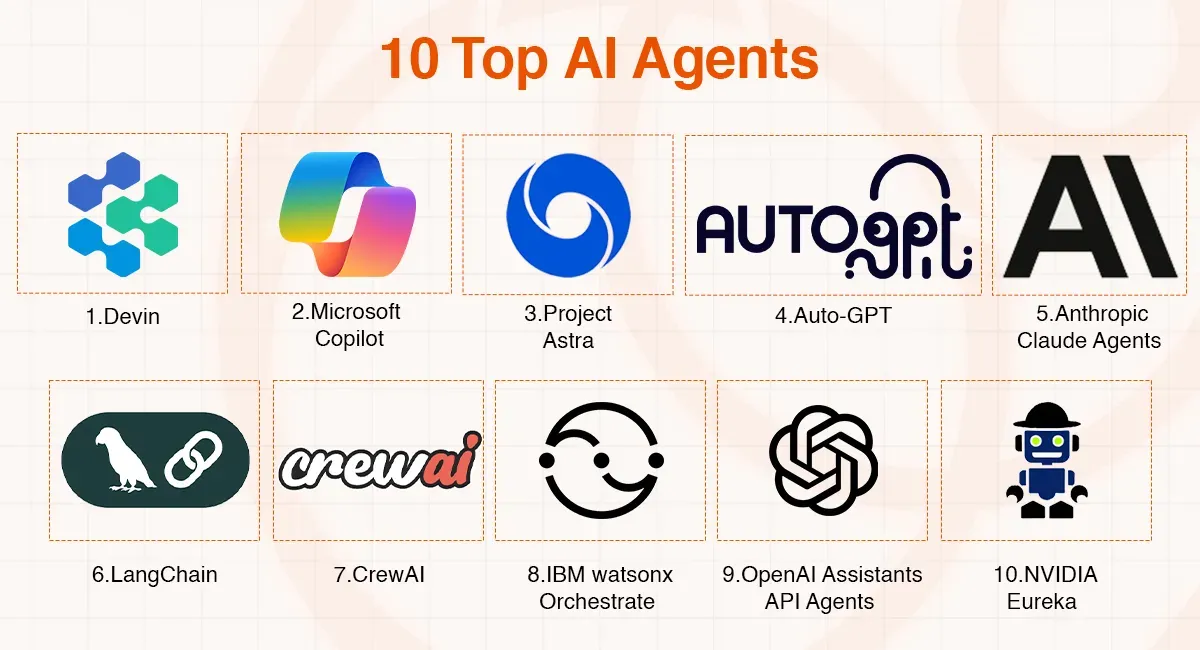
10 Top AI Agents
This ultimate list of top AI agents identifies the best AI agents and agent frameworks that are redefining the industry standards.
Devin:
Type: The software engineer who works independently.
Features: Devin, created by Cognition AI, is one of the best AI agents since it is the first full autonomous AI agent in the world, with the ability to plan and execute complex software engineering tasks end-to-end. It can work as a human developer, has its own shell, code editor, and browser. Its main strength is that it can be used to process complete development projects based on a single text prompt, much faster than the software development lifecycle. Devin is a real free-stand developer.
Functions: Autonomous software engineering is the main role of this AI agent. This involves code writing, bug fixing, unit testing, and application deployment to staging environments. It is able to acquire new technologies, read documentation, and write reports on its own development, which is why it is a breakthrough on the list of AI agents in the world of technologies.
Microsoft Copilot:
Type: The enterprise productivity agent.
Features: The Microsoft Copilot is an AI agent that Microsoft implemented in the entire 365 suite, Word, Excel, PowerPoint, and Teams, and it has become a part of the suite. The key benefit of this AI agent is the contextual awareness, such as the agent can read and use the information in the entire Microsoft 365 graph (emails, documents, calendars) to accomplish tasks. This close form of integration renders it one of the most popular AI agents in the business environment, enhancing the productivity of individuals and groupings instantly.
Functions: Enterprise workflow automation and content generation are the main roles of this agent. There are such specific tasks as summarizing long email messages and meetings, creating a document, producing data analysis reports in Excel, and creating an initial presentation, which are founded on natural language instructions. It is an AI agent that is able to delegate and manage activities in the enterprise environment.
Project Astra
Type: The Full talk agent.
Features: Google DeepMind has created Project Astra, which is the concept that will become the future of the Gemini models and will be one of the primary members of the highest AI agents. It is an artificial intelligence agent that can interact in real-time in multi-modes, that is, can see, hear, and talk, and possesses a profound knowledge of its surroundings. Its benefit is that it can be smoothly and naturally integrated into everyday life and, therefore, serve as a genuinely universal, context-sensitive digital assistant, which is able to think visually and audibly and reason at an advanced level.
Functions: The role of this AI agent is real-time contextual assistance. It covers responding to queries on physical items on live video feed, recalling the location where a user left their keys, and giving step-by-step instructions based on what it can see in the immediate surroundings of the user. Astra is an AI agent with this multi-modality.
Auto-GPT:
Type: The automated goal executor.
Features: Auto-GPT is an innovative open-source initiative that commercialized the idea of the autonomous AI agent. The primary strength is that it shows the self-sufficiency of AI agents, i.e., they can generate and cope with their own activities. Being an initial project that demonstrated the ability of an AI agent to work without constant human information, it profoundly shaped the path of other AI agent firms.
Functions: It is based on recursive goal decomposition. It means that it takes a complicated, high-order, and even abstract objective (e.g., grow my online brand) and then independently decomposes it into a series of manageable sub-tasks (e.g., research niche, create five social media posts, analyze engagement), constantly refining its action plan.
Anthropic Claude Agents:
Type: The safety-aligned enterprise agent.
Features: Anthropic produces AI agents that are based on Claude LLMs. One of the strengths of this agent is that it focuses on the safety and principles of constitutional AI, and this guarantees that this AI agent functions within set, ethical boundaries. This alignment orientation renders Anthropic Claude Agents as one of the most optimal AI agents in high-stakes enterprise settings where reliability and compliance are the key factors. The AI agent boasts of excellent reasoning and planning abilities.
Functions: The role of this artificial intelligence representative is robust reasoning and tool use in secure environments. They are good at multi-dimensional analysis, summarization of proprietary data, and the production of detailed reports, and have the capability of operating more multi-step business logic while still staying within constitutional AI limits and rigid enterprise procedures.
LangChain:
Type: The framework of agent orchestration.
Features: LangChain is not just an AI agent but a framework that is critical and open-source and that is extensively used by almost all AI agent companies. Its most important strength is the ability to offer the required modularity and standardization to develop complex AI agents. It democratizes access to the development of truly autonomous systems, in that it provides pre-built blocks to each phase of the operation of an AI agent.
Functions: Its role is agentic system architecture and orchestration. It gives the means of chaining together all the LLM calls, managing persistent conversational memory, incorporating external data sources (RAG) into context, and linking the AI agent to a variety of APIs and tools. It is the piping of present AI agents.
CrewAI:
Type: The multi-agent collaboration framework.
Features: This framework, developed by CrewAI, Inc., allows Multi-Agent Collaboration, and this is the major benefit of this framework. It enables developers to specify a group of specialized AI actors with specific roles and backgrounds (e.g., researcher, content strategist, editor) who can jointly solve complicated problems. Such a model substantially raises the complexity of the tasks that the AI agent system can deal with through the simulation of human organizational structure and delegation.
Functions: The role of this system is task delegation and collaborative execution. It coordinates the working process among specialized AI agents, making sure that information is transferred appropriately and conflicts are eliminated to reach a single and high-level objective, such as the creation of a complex, multi-faceted report on the market.
IBM Watsonx Orchestrate:
Type: Business task automation agent.
Features: IBM has a Watsonx orchestration platform, which employs advanced AI agents in the enterprise. Its advantage is that it targets the highly regulated business climate, and that it provides a no-code platform, which makes it secure and compliant. This enables it to be a reliable AI agent solution to automate mission-critical business processes at scale, and is a leader on the enterprise AI agents list.
Functions: The main function of this AI agent is to regulate workflow automation. It is a routine and complex business automation, such as HR onboarding, scheduling, data input in various enterprise resource planning (ERP) systems, and the coordination of service desk requests, and fits in with the current enterprise applications.
OpenAI Assistants API Agents:
Type: The Custom Goal-Oriented Agents.
Features: The OpenAI Assistants API allows developers to create their own powerful and custom AI agents, which can be deployed and operated under the power of the strong OpenAI infrastructure. Its important benefit is an easily scalable environment where one has a controlled environment to develop production-ready agents containing embedded capabilities such as code execution and data retrieval (RAG), resulting in much less development overhead to create specialized AI agents.
Functions: This platform has the role of specialized application deployment. It enables the development of specialized AI agents with long-term memory and tool utilization of particular goal-driven tasks, including a custom data analysis AI agent in a finance department or a personalized learning AI agent in an EdTech firm.
NVIDIA Eureka:
Type: the robotics and control agent.
Features: NVIDIA Eureka is an AI agent that works in physical control and robotics. Its fundamental strength is that it can be used to apply high-level thinking of LLMs (such as GPT-4) to physical world problems. This AI agent writes the code instead of commanding robots to move tediously, as it takes time to get the robots to learn complex functions, and this AI makes this process fast.
Functions: This AI agent’s function is to automate the reward function generation of robotics. It monitors a robot trying something, and autogenerates and optimizes the reward functions for the training of reinforcement learning (RL) through an LLM. This enables the AI agent to teach robots to carry out complicated manipulations such as opening a drawer or twirling a pen.
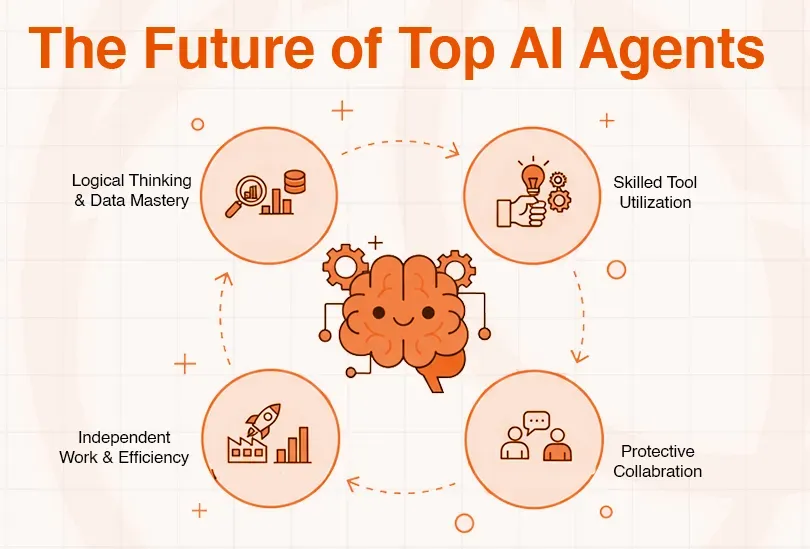
The Future of Top AI Agents
The trend is obvious that the most successful AI agents are getting more adept at thinking logically, more skilled in utilizing sophisticated instruments, and more cooperative. They are changing from being assistants to becoming proactive partners and independent workers. The current evolution of AI agent businesses is not merely about the creation of smarter software, but it is the design of the new breed of digital labor force.