The AI in marketing automation relies on intelligent computer rules (AI-driven marketing automation) rather than on outdated, fixed rules. This allows you to customize, identify the best customers (predictive lead scoring) in seconds, and amend your ads on the fly. Leveraging such marketing artificial intelligence in businesses yields greater profits and, at times, overpowers competitors with a distinct custom AI and marketing automation plan.
The marketing world is evolving rapidly. These days, success does not only depend on sending emails or publishing on social media, but also on sending the message to the right person, in the right place, at the right time. AI in marketing automation makes this possibility attainable.
When it comes to marketing automation. AI is a game-changer. It transforms marketing into intelligent and data-driven decisions rather than just simple and preset rules. This integration of AI in marketing automation is leading to a future in which all interactions that a customer has are highly relevant and personalized.
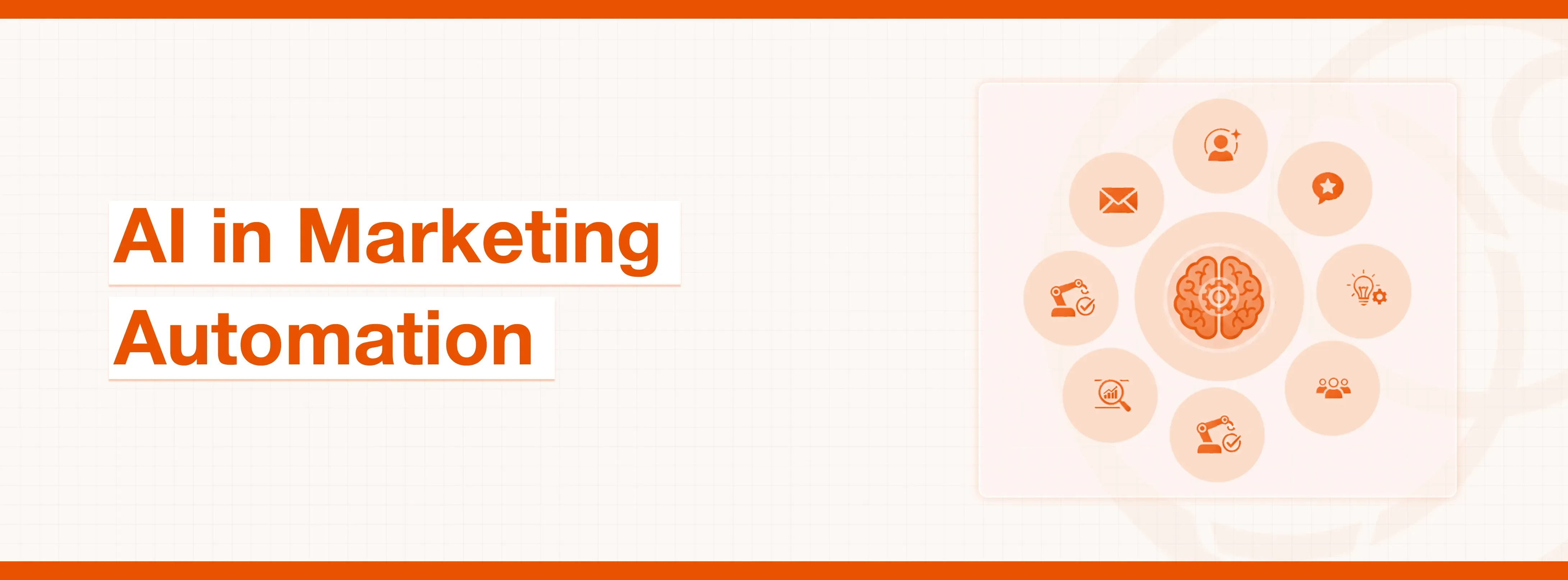
The following are 8 ways in which AI is changing strategies and providing enormous outcomes in businesses.
Hyper-Personalization on a Large Scale
Conventional marketing automation allows a person to enter the first name of a customer in an email. AI in marketing automation is much more than that. It processes large volumes of customer data, including their browsing history and purchase behavior, as well as their current clicks and geographic location, to generate algorithms.
Such a strong analysis makes it possible to perform hyper-personalization on a large scale. A marketing automation system with AI can dynamically update the image of the product, headline, and even the discount offer on a web page or in an email, in real time, for even a single user. This is made possible by the incorporation of AI in marketing automation, where each touch point is made to appear to be custom-made. This increases the engagement and conversion rate significantly more than basic automation would ever achieve. The extent of personalization proposed by AI in marketing automation is its greatest strength.
High-quality Customer Segmentation
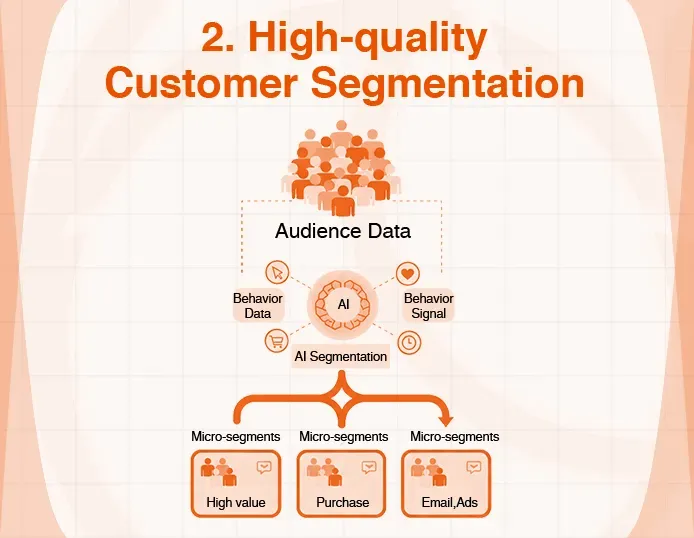
The best marketing begins with having knowledge of your audience. The strength of AI in marketing automation is that it can build super detailed customer segments within a second.
Stop thinking in general terms such as age or gender. Marketing automation with AI considers hundreds of behavioral cues in order to classify customers into “micro-segments” depending on their intent, likelihood of purchasing, and communication preferences. This is an in-depth segmentation that ensures that you have a highly relevant campaign all the time. A marketing automation platform can also set an AI to recognize a customer who is likely to become a churn customer and automatically transfer them to a special win-back campaign, preventing the loss of revenue before it occurs. This is the exact type of segmentation that is a fundamental feature of modern marketing artificial intelligence.
Predictive Lead Scoring
Not every lead is created equal. Hand scoring is not only time-consuming but may also be a case of basic and partial data. This is a very important process that AI in marketing automation does with impressive precision.
The predictive analytics of these systems are based on a score assigned to each lead that is determined based on the probability of conversion. They examine the past data in order to identify the trends that predict a sale. This implies that your sales force will not waste time on cold leads, but with the help of AI in the marketing automation system, it can only target the high-value leads that are identified by AI. This is not only time-saving but also cost-efficient, and the return on investment (ROI) is tremendous.
Improved Campaign Optimization in Real Time
AI in marketing automation has one of the largest advantages because of its rapid learning and adaptation. Conventional marketing involves manual A/B testing, which is slow and can only test a few variables simultaneously.
It performs continuous multivariate testing across all campaign variables at the same time, such as headlines, images, timing, and ad copy. It also continuously tracks performance and secures budget and traffic for the most successful variations automatically at once. This real-time, dynamic optimization will have your campaigns constantly performing at their best, and that is one of its significant competitive features.
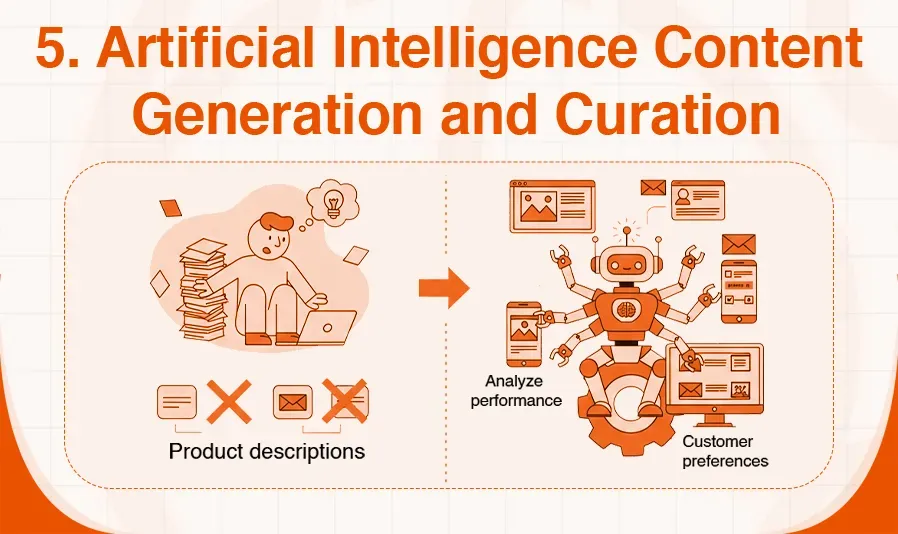
Artificial Intelligence Content Generation and Curation
Developing enough relevant content to be used in personalized campaigns is a huge job. But AI in marketing automation makes it easier to create and manage content.
By applying generative models, AI-driven marketing automation systems can rapidly generate variants of ad copy and email subject lines as well as product descriptions to meet the needs of particular customer groups. Moreover, it can also be used to analyze performance and customer preferences, then arrive at the most appropriate piece of content that can be served to an individual customer at any particular time. This capability to achieve the delivery of personalized content on a large scale is one of its strongest features
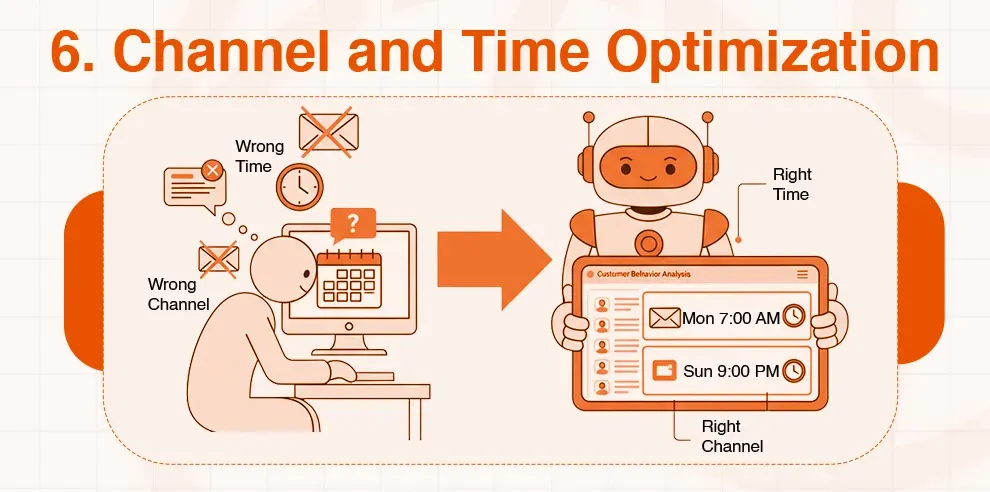
Channel and Time Optimization
Everything in marketing is about timing. An email with the wrong time and channel may result in lower open rates and fewer opportunities.
There is a solution to this, which AI in marketing automation provides by examining the customer behavior to identify the most appropriate time and channel to communicate with each customer. For one individual, the ideal time of an offer can be 7:00 AM on Monday through email. In the case of another, it could be a social media advertisement at 9:00 PM on Sunday. The decision in the marketing automation system is made automatically by the AI, and the possibility of engagement grows.
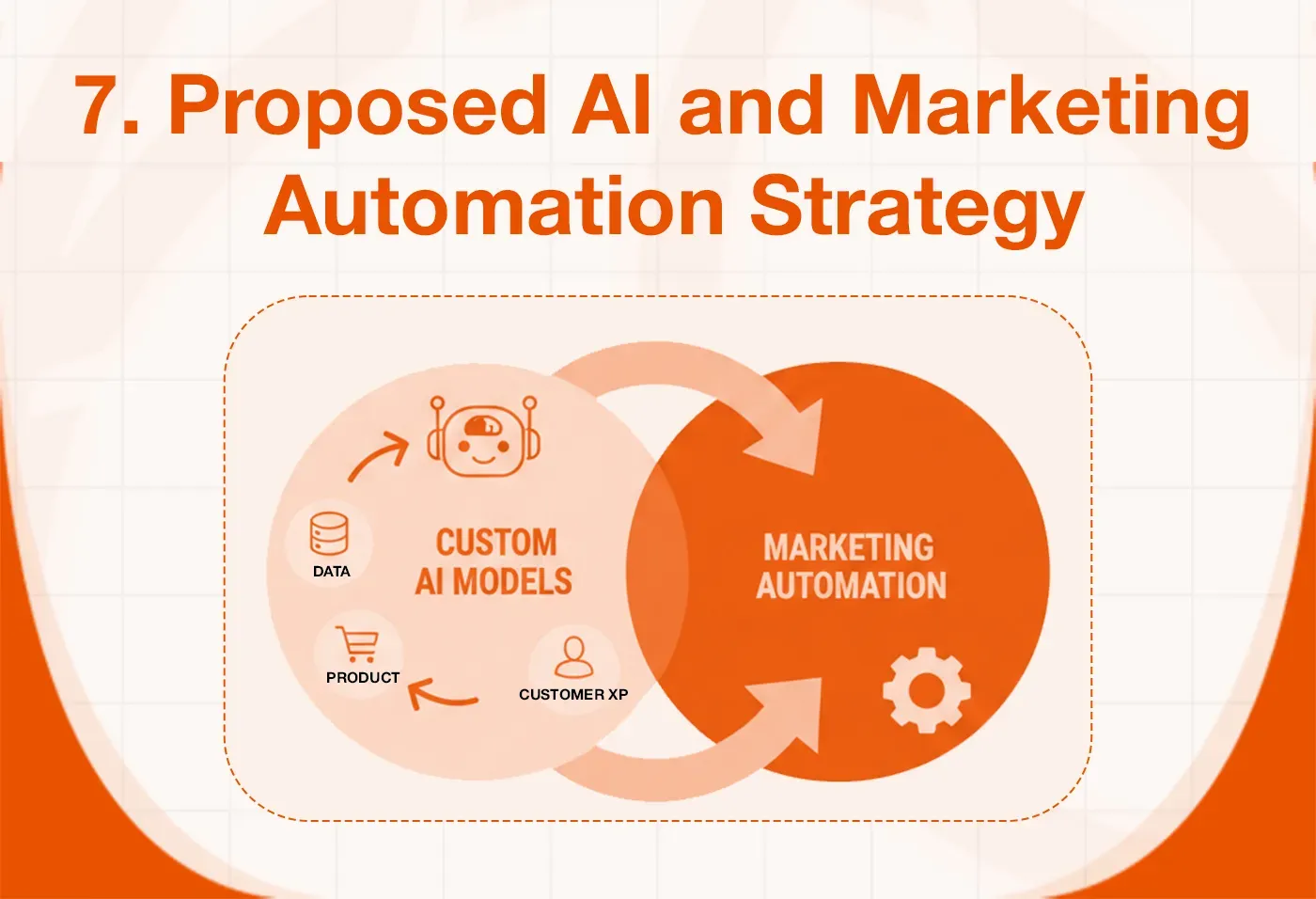
Proposed AI and Marketing Automation Strategy
To gain a real competitive advantage, companies are no longer depending on usual software, but instead are adhering to a custom AI and marketing automation plan. This entails the construction (or incorporation) of AI models specific to the data, products, and customer experience of a company.
A custom AI and marketing automation plan can concentrate AI marketing automation strength on a niche. high-value issues, including anticipating the precise goods a new customer will purchase or predicting stock levels through marketing actions. This tailor-made solution brings the full strength of AI to marketing automation and provides a competitive advantage in the market.
Increased Productivity and Economy
The biggest advantage of AI in marketing automation, perhaps, is the enormous enhancement of team efficiency. AI in marketing automation saves the marketer by doing all the hard work, such as automating data analysis, monitoring campaigns, scoring leads, and distributing content.
This automation would allow a smaller team to handle larger and more complex campaigns, which would directly lower the cost of the operation. This is because a combination of less manual work and more successful performance in the campaigns leads to a gigantic rise in ROI. All businesses that want to gain effectiveness and develop are embracing AI in marketing automation.
Conclusion
AI in marketing automation is no longer an optional tool but the engine that is leading the modern competitive marketing. Hyper-personalization, creating a custom-made strategy, and not only that, but also the technology is on hand to make businesses attain unmatched efficiency and conversion rates. Companies worldwide are rapidly adopting AI marketing automation as a way of gaining a competitive advantage. The most important action that a business can perform to achieve its success in the future is the use of AI in marketing automation.