What is Geo? Understanding Generative Engine Optimization (GEO)
TL;DR:
Understand Generative Engine Optimization. This is a vital new approach that enables your content to be AI friendly. With Generative Engine Optimization, you can ensure direct responses and summaries from new AI search engines. You will increase the reputation and presence of your brand on the Internet. Keep up with the changes in the evolving search landscape with GEO.
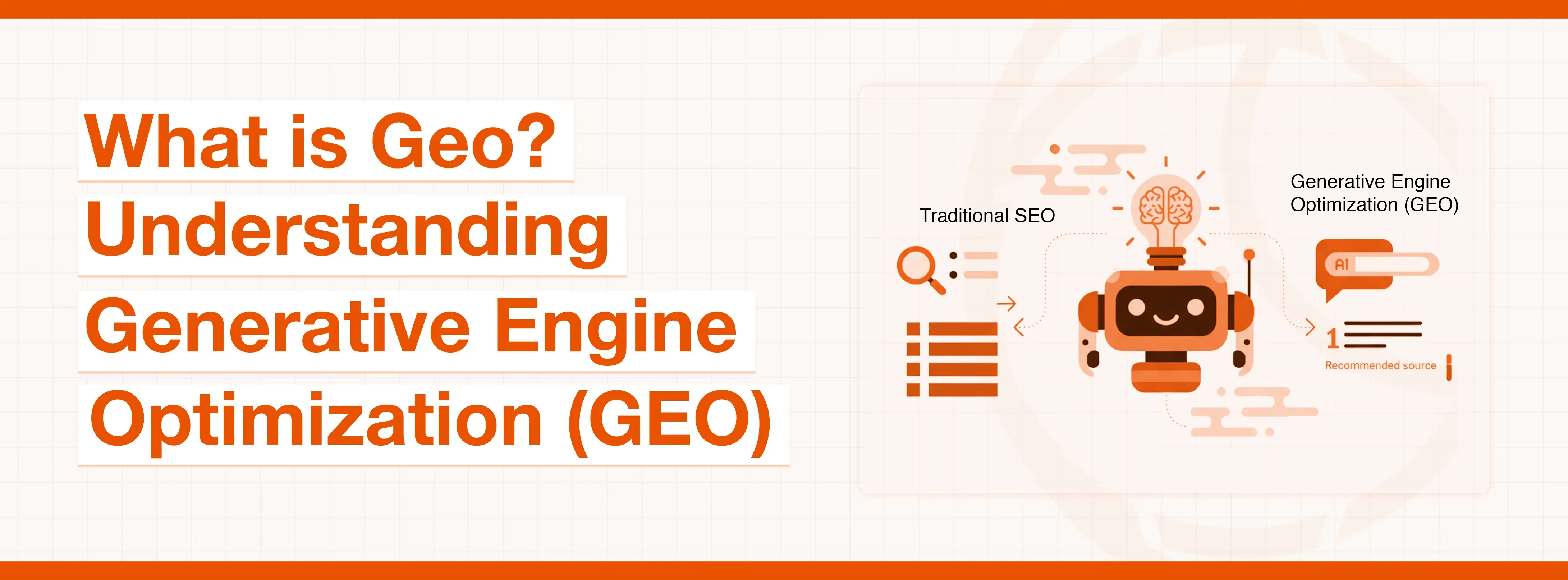
A newer strategy in digital marketing and search engine optimization (SEO) is called Generative Engine Optimization (GEO), which aims to address the emergence of generative AI-enabled search engines. Generative Engine Optimization (GEO) differs in that it focuses on content optimized to rank high in AI-driven search tools. These include platforms like Google Search Generative Experience (SGE) and Microsoft Bing AI, and any other conversational AI assistants. Their search is not only limited to referring users to web pages, but they also provide answers directly.
Simply put, GEO is all about ensuring your content gets AI-friendly in order to be placed prominently in the AI-assisted answers and responses when generative search engines are used to summarize content, or reply to the user query.
Understanding the Shift from Traditional SEO to GEO
In the past decades, search engine optimization was focused on the algorithms of search engines that placed pages by such factors as keywords, backlinks, and visitor interaction. But this scenario has completely changed:
Generative AI Search Engines are capable of creating and writing answers in real-time by arranging multiple sources. Rather than presenting 10 blue links, they will present summaries created by the AI with some recommended sources attached.
In many cases, users are getting their answers without even clicking on an external URL, meaning that the visibility war has now moved within the AI-created built summary instead of the SERP list.
When it comes to SEO vs GEO, the latter tackles the question of making content appear in such a way that generative engines know how to read it, trust it, and use it as an answer.
The Key Characteristics of Generative SEO
GEO is characterized by a number of distinct qualities that make it different from traditional keyword optimization.
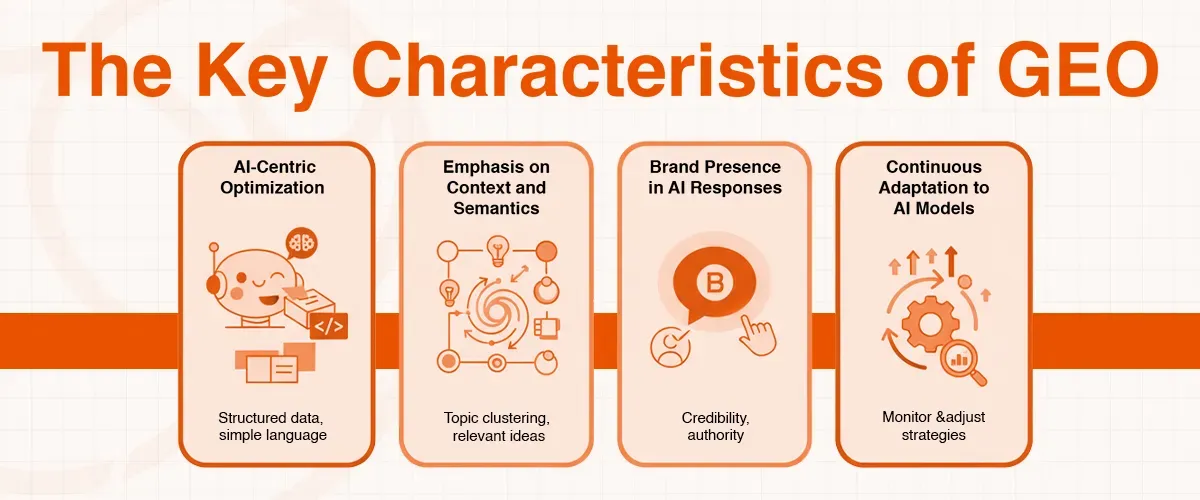
1. AI-Centric Optimization
Rather than just optimizing to use keyword-based algorithms, GEO ensures that AI models can easily consume your work. This includes the use of structured data, simple language, and contextual data, that can be integrated directly into the text AI-generated summaries.
2. Emphasis on Context and Semantics
Generative AI is modeled on semantic knowledge; that is, it searches connections among concepts instead of only showing results with the same keywords. GEO is aimed at topic clustering, relevant ideas as well as the fact that content has to be correctly organized in order to generate a better understanding of AI.
3. Brand Presence in AI Responses
In traditional SEO, your objective was to be listed on the first page of search. In GEO, the objective is to make it to the final generated answer that AI provides before users. This requires credibility, authority, and relevance.
4. Continuous Adaptation to AI Models
With the rapid evolution of AI search engines, GEO would have to monitor the way generative results are displayed and adjust strategies accordingly.
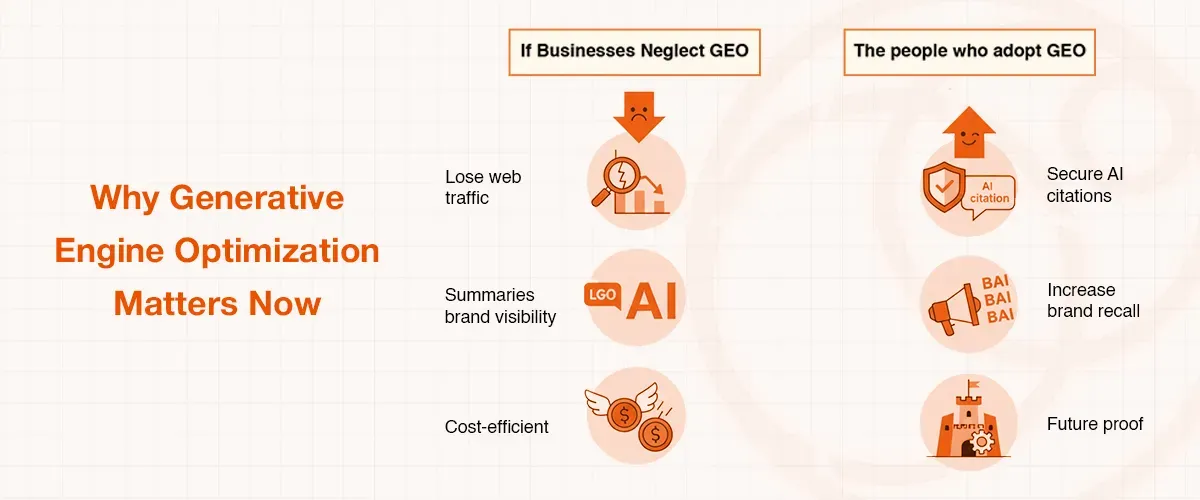
Why Generative Engine Optimization Matters Now
The rise of generative search engines is not a matter of speculation in the future, but it is already happening . Google’s SGE is being made available worldwide, and Bing AI has already become a part of the Microsoft search experience.
If businesses neglect GEO:
- They may also lose web traffic as direct AI answers will be offered.
- The first movers might eventually control AI summaries' brand visibility.
- The Search engine marketing (SEM) approaches may not be as cost-efficient without complementary GEO.
On the other hand, the people who adopt GEO, can:
- Secure AI citations that act as recommendations by search engines.
- Increase brand recall by mentioning them repeatedly in generative statements.
- Future-proof their content strategy against additional AI search impacts.
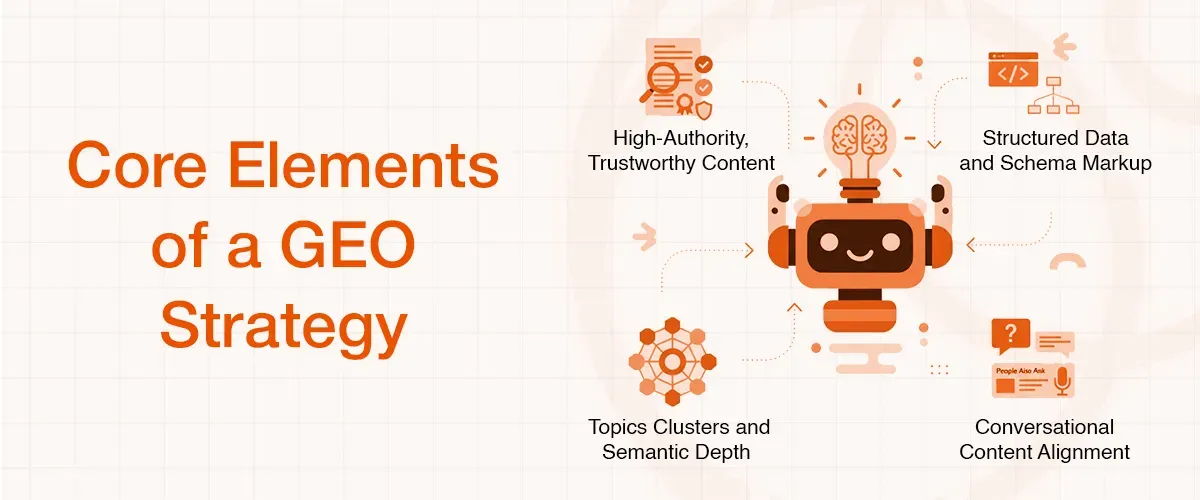
Core Elements of a GEO Strategy
High-Authority, Trustworthy Content
Generative AI engines prioritize authoritative and reliable sources of information.
To do this:
- Share high-quality quality researched, correct, and timely information.
- Provide references, citations, and ideas.
- Demonstrate expertise through author credentials, as well as transparent sourcing.
Structured Data and Schema Markup
It is easier to have an AI process and incorporate the contents using schema markup (such as FAQ, How To, Product). The data format indicates content type, purpose, and connection, which generative systems use in the correct understanding of the text.
Topics Clusters and Semantic Depth
GEO prefers connected hubs of content, instead of stand-alone keyword articles, in which one article leads to a more general notion. This creates topical authority and increases the probability of your site being used by AI as one of the main sources.
Conversational Content Alignment
Generative engines react to natural language queries, so writing content to sound conversational with question-answer structures is a good way to go. The addition of such elements, such as “People Also Ask” type of sections, makes AI more usable.
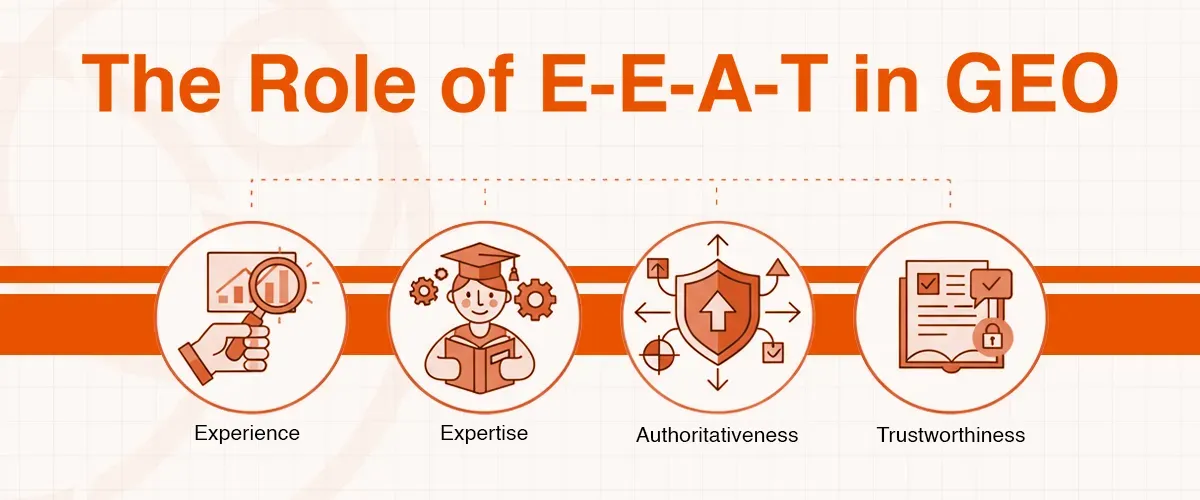
The Role of E-E-A-T in GEO
Google’s E-E-A-T guidelines: Experience, Expertise, Authority, and Trustworthiness remain crucial in GEO with an extended focus, such as:
- Experience: Presentation of personal knowledge (i.e., case studies, personal accounts).
- Expertise: The authors included are the experts themselves.
- Authoritativeness: Building a good reputation in the domain by citing and referencing through backlinks
- Trustworthiness: Being open about information sources, responsibility, and intentions.
Generative AI engines are aimed at filtering unreliable and questionable content. Thus, weak E-E-A-T signals will lower the possibilities of AI citation.
How GEO Interacts with Generative AI Search Engines
A generative search engine may do the following when a user searches for terms like: best running shoes for flat feet:
- Scan its sources of live web and training data.
- Locate high-quality, relevant information.
- Draw a summary: In the case of flat feet, professionals advise: to wear shoes with arch support, such as Brand X and Brand Y…
- Provide references to cited materials.
With proper GEO:
The cited expert advice, in that summary, could be your writing. Brand awareness increases even without a click. Over time, frequent references to AI build up confidence in consumers.

Benefits of Generative Engine Optimization
Greater AI Visibility:
Your content is displayed in AI summaries, featured snippets, and conversational responses, giving you an even greater reach than search ranking.
Competitive Edge:
The possibilities of GEO will enable early adopters to gain an advantage over competitors who are yet to adapt to the new process of AI-driven discoveries.
Long Term Content Value:
Artificial intelligence optimization will help you keep your content relevant as search algorithms change.
Brand Authority Building
Being referenced by generative search engines becomes an aspect of prestige that signals credibility to the audience.
Challenges and Limitations of GEO
Contrary to this, GEO is faced with very unique challenges despite its promising nature:
Fewer Click-Through Rates (CTR):
If AI answers everything, people might not even visit your site, which will make brand mentions as important as traffic.
Algorithm Opacity:
GEO involves a lot of trial and error in contrast to traditional search algorithms due to the relative opacity of generative AI models.
Fast Pace of Technology:
The GEO strategies will have to be updated constantly, considering the rapid progress of advancements in AI.
Citation Wars:
The competition is very fierce as a few sources are cited in AI summaries.

Steps to Implement GEO in Your Website
- Audit Your Current Content: Identify which pages are important and check whether they are listed in an AI search summary already. Tools like SGE previews and Bing Chat can help.
- Increase Semantic Relevance: Add related words, synonyms, and context for AI understanding.
- Optimize for Conversational Queries: Put FAQs and questions in their natural forms in your content.
- Improve Author & Source Credibility: Put author bios, qualifications, and references in order to develop authority.
- Leverage Structured Data: Implement schemas that specify the nature of your content and enhance your overall site structure.
The Future of GEO
As generative AI search engines mature, GEO will likely become the norm as part of an SEO strategy.
We can expect:
- More potential analysis tools for AI citation.
- More voice search and conversational artificial intelligence are getting incorporated into optimization efforts.
- The growth and importance of multimedia AI optimization (photos, videos, interactive content)
- Organizations that evolve quickly will not only manage to survive but also to flourish during this new search era.
Conclusion
Generative Engine Optimization is not just a trend; it is the next stage of how industries and businesses will be discovered online. Geo is not a replacement for traditional SEO, rather it complements it. As search engines shift from delivering lists of links to providing AI-generated answers, visibility tactics must adapt. GEO is about ensuring your content is understandable by AI, and is authoritative, and contextual to a point that it can be adapted into generative responses.
With structured data, semantic depth, and E-E-A-T-friendly signals, brands can become authoritative voices within the new AI-driven search environment. In the near future, the question won’t be “Can people find you on Google?” but rather “Does AI recommend you?”
That is where GEO comes in to ensure the answer is yes.