You have read a hundred articles about SEO content writing, and you are even more confused at the end. They consist of technical words, and everything looks impossible. This is what I should have learned many years ago. When I started writing to optimize for search engines, I quickly realized it was easy. All it takes is knowing what people want to know and presenting it in an easy, enjoyable format. There is no magic formula or secret trick; it only takes good writing and a smart strategy that really works.
When I was starting to create my SEO content, I would stuff as many keywords into each sentence as possible. My articles sounded like a robot being interviewed. My obsession with satisfying search engines also led me to neglect the human eye when reading my work. As a result, my content never scored highly, and when it did, no one bothered to read it because it felt impersonal and unnatural. Everything changed when I learned that Google's algorithms are intelligent enough to recognize when you are genuinely communicating with your audience rather than trying to outwit the system.

Understanding Search Intent Before You Start Writing
To successfully use AI for SEO writing, you must be aware of why people are searching your topic before you write anything, and this is known as search intent, which is the motivation behind every search. When an individual enters the query on how to write SEO articles on Google, what exactly does he seek? Are they novices in need of fundamentals, or are they more proficient writers in need of a sophisticated style, or are they attempting to find someone to employ, rather than learning how to do it themselves?
The trick to consistently nail search intent is to review what is already ranking for your target keyword, open the top five search results, and read them to understand the format and how comprehensively they are presented. In this study, you will know precisely what Google believes searchers desire, and what matters immensely in creating an SEO optimisation search writing strategy.
When a person is searching for tips, and you attempt to sell them services instead, they will leave at once, and Google sees such exits as an indication that what you provide is not what people actually require. Understanding search intent is crucial when writing for SEO optimization.
How To Utilise Keywords in a Natural Way
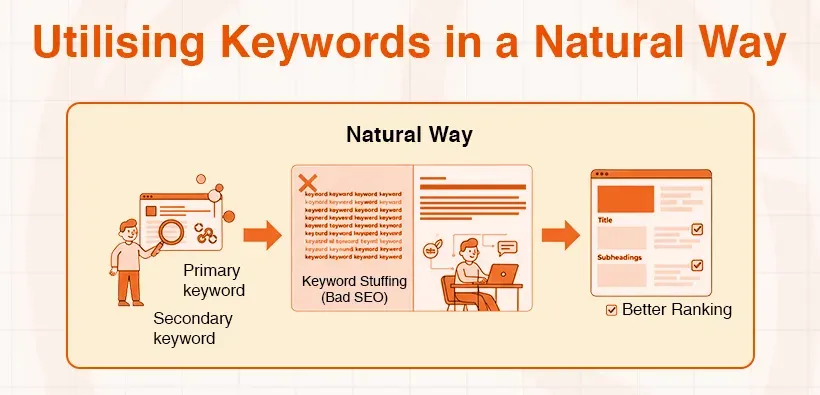
Keywords remain relevant in 2026, but they are not used in the same manner as before. Contemporary search engines think of context and synonyms. I also use tools such as SOLVE BY SAAGA and Ahrefs when researching keywords, and in this case, SOLVE BY SAAGA is a better tool since it helps to find gaps in the existing literature, whereas Ahrefs provides specific difficulty scores and the volume of search data.
Your main keyword must be used in strategic positions throughout your content. Place it in your title at the start of the beginning, in your introduction at the first 100 words, in at least one of the subheadings, and where it is contextually appropriate to include it.
When you have to cram a keyword into a sentence, pause and reword it more naturally, even if that requires you to use a synonym for the phrase you had in mind. Writing for SEO optimization requires strategic keyword placement without compromising readability.
The secondary keywords are equally significant to your main one since they reveal to search engines that you are broadly discussing the subject matter. The following is what I do: I write my first draft without thinking too much about keywords, rather describe clearly and exhaustively, and then I revise it by keeping SEO in mind to make sure to include the keywords where they naturally fit.
Designing Hooks that Help Keep the Readers Interested
The greatest misconception when writing SEO-friendly articles is that they shouldn’t be too creative, and the writers pay so much attention to optimization that they do not remember how to make it interesting and captivating.
Your introduction must be able to attract attention at first sight, so you want to start with something relatable, whether it is a familiar problem, a startling fact, or a situation that your reader can relate to and that gives them a reason to continue reading rather than banging the keyboard back.
As soon as you hook them, you need to keep them entertained to the end of the piece through short paragraphs, since large text blocks are not pleasant to read on the internet. Alter your sentence arrangement to bring rhythm that is natural, incorporate terse sentences with longer descriptive sentences to bring depth and explanation, and this brings a flow that makes the process of reading an enjoyable one.
Do not use generic phrases that scream SEO articles, since you are aware of them, such as In the modern digital world or It goes without saying, as they add no value to your article and make your readers feel that they are reading something mechanical instead of something useful.

Organising material most effectively
Form is nearly as important as the content, which initially surprised me to learn about writing to ensure it is SEO-optimised, as I had assumed that writing was only about what you say, and not about how you arrange it. Your headings ought to be descriptive in themselves, such that you can proudly have a person read only your H2 and H3 tags and know what your article will touch upon, fully.
I write with an outline first because it keeps me on track and makes me go through the topic I am discussing in detail, instead of going off track and discussing irrelevant details. In any given section, make the most important information first, rather than placing your main point at the end; make it clear in the beginning, and then explain using details and examples that will substantiate your main point.
Formatting is a useful technique to help draw attention to important information, but should be used sparingly, with important phrases boldened, and lists to help your information be easier to scan, but should not be overused, as you will make your content look like a series of lines, and it is not easily readable. Writing for SEO optimization includes proper content structure and formatting.

Optimisation of Meta Descriptions and Title Tags
Your title tag is, perhaps, the most significant SEO aspect on your page since it is the first thing to appear in search results, and it is usually what makes or breaks whether someone will click what you have to say or will pass your content by and go to find something more attractive. An excellent title tag has your keyword at the top, it effectively explains what the page is all about, and most importantly, lures people to go ahead and read your entire article.
The meta description does not directly influence ranking, but has a very significant influence on the click-through rates since this is your 155-character sales pitch and your opportunity to make the searchers believe that your content is what they need. Write your meta description as though you are responding to the question of the searcher, place your keyword there naturally, but put more emphasis on being persuasive and straight to the point, what value you are offering.
Do not be general; it makes the message weaker when we say Learn about SEO writing, since discover the precise mechanism that best writers use to place articles on the first page of the search result list is specific and alluring enough to gain clicks. Writing for SEO optimization requires compelling meta descriptions and title tags.
Developing Internal and External Linking Strategies
Internal linking is good for user experience and search ranking, but most writers fail to recognise this fundamental element of writing to optimise search. By connecting to other related information on your site, you are assisting the reader in finding more useful information, which will keep them longer on your webpage, and also informing the search engines that you are well covered on a similar theme.
Include descriptive anchor text that explains what the reader will get when they make a click, and not some generic term, such as click here Use a specific term, such as learn more about keyword research strategies.
Although internal links ensure you retain readers on your site, external links to authoritative sites are a part of the trust and credibility you develop with your audience and search engines. Whenever you use data, refer to research, or refer to industry best practices, include links to your sources since this indicates to readers that you have conducted in-depth research and that the information in your work is grounded in credible evidence.
Be selective and prefer authoritative sources in your niche, such as industry publications, research institutions, and reputable blogs, rather than random websites that do not add to credibility. Writing for SEO optimization involves strategic linking to enhance credibility.
Optimizing Images for Better Readability
Photos help to keep your content more interesting and easier to comprehend, yet they provide SEO opportunities that numerous authors overlook altogether. Each image must be accompanied by descriptive alt text to allow users with visual impairments to understand the image and search engines to comprehend what the image represents to rank it.
Write alt text that fully describes the image and will naturally use relevant keywords where needed, and describe file names such as seo-content-structure-example.jpg rather than using generic names such as IMG 1234.jpg.
Search engines have become so advanced in gauging how easy to read and understand content, and this has necessitated the consideration of readability conditions in writing to optimise the results of the search engine.
Write at a level that your target audience can understand, and in most web communications, this means writing at the level of about eighth-grade reading, but this does not imply dumbing down your work, but being clear, not needlessly complex.
You should use transition words such as; however, therefore, for example, and in addition since they show the relationship between concepts and smooth flow of your content. Writing for SEO optimization also means optimizing images and ensuring readability.
Updating Content and Measuring Success
The constant revision of existing content is one of the best basic SEO techniques, rather than necessarily developing new content. Search engines prefer original content, and if you have an article that is performing well but is becoming old, you can update it and gain significant momentum without necessarily having to create a completely new article.
Consider old content and refresh outdated content, links that are not working, and paragraphs that might need more information; and revise statistics and include some new examples reflecting the recent events in your field.
What you cannot measure, you cannot improve, and to become a successful writer regarding SEO optimization, it is important to find the right measurements that should be followed. Monitor organic traffic to determine whether people are finding what you are posting via search engines and track engagement metrics such as time on page and bounce rate, since these will tell you if your content is meeting the needs of searchers.
Conversions are the best gauge of success as they indicate whether or not readers are performing the actions you want them to perform after reading your content, such as signing up to newsletters, downloading content, or purchasing something that yields revenue. Writing for SEO optimization requires continuous monitoring and improvement.
Final Thoughts
SEO optimization writing is not a process to deceive search engines or compromise quality to achieve a good position, but rather a matter of producing truly valuable content that provides value to your readers and adheres to the best practices that make search engines easy to comprehend and rank highly. The landscape has changed drastically in the last couple of years, and the strategies that worked five years ago not only fail to work today but may even damage your ranking since search engines have become so advanced at identifying manipulation.
One single piece of advice I can give you when it comes to writing for SEO optimization is as follows: worry more about your readers than about rankings, since when you truly desire to help people and take the time to listen to their questions and problems, the rankings will come naturally. Search engines have become incredibly capable at ranking and rewarding content that genuinely benefits the user, which in turn means that the most effective approach is to produce content that is as helpful as possible, with a few simple rules of thumb for optimisation that help make your work easy to find. Writing for SEO optimization is ultimately about serving your readers first.