AI marketing involves smart technology to make decisions autonomously. You save time and money by using AI in digital marketing. By observing how AI marketing works, you realize how AI is transforming digital marketing in the present day. The most effective way to prepare for how AI will impact marketing tomorrow is to learn how to utilize it today.
Artificial Intelligence is a reality of today and a key driver of growth for businesses. When you need to expand your business or improve your skills, you have probably asked the question: What is AI marketing?
In this article, we are going to venture into the depths of AI-driven digital marketing. We are going to review the simplest definition of AI marketing to the complex strategies on how to use AI in marketing. At the conclusion of this guide, you will clearly understand the application of AI in marketing and why it is the most significant tool of a modern marketer.
Background and History of AI Marketing
To begin with, let’s examine a clear definition of AI marketing. AI marketing is an approach of automating the decision-making process based on data with the help of technology. Such technologies are machine learning, natural language processing, and deep learning.
Marketing used to be conducted on “gut feelings” or general surveys in ancient times. Now, AI and Machine Learning in online advertising enable the systems to understand the behavior of visitors in real-time. Instead of humans taking weeks to look at a spreadsheet, an AI looks at millions of data points within a second.
The use of AI in the marketing field can be simply described as the work of a very intelligent assistant. It does not merely store information, but it also learns from it. This is what has made the AI influence on marketing so enormous; it has the speed and accuracy that humans are not capable of on their own.
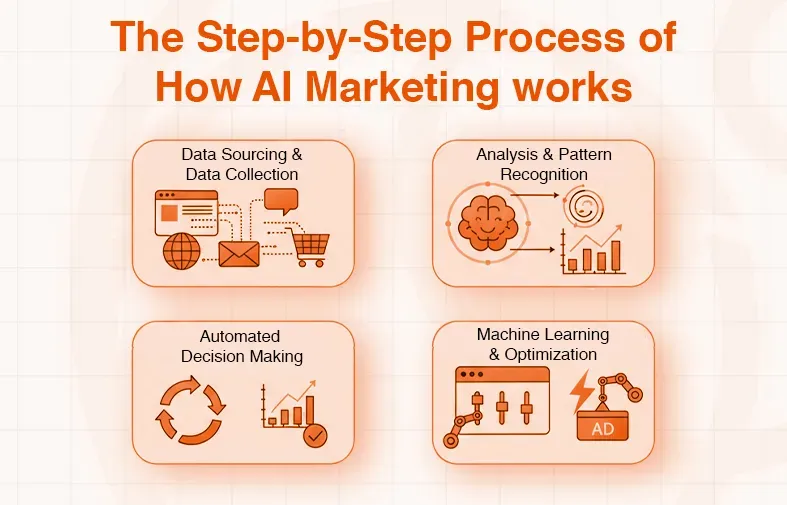
The Step-by-Step Process of how AI Marketing works
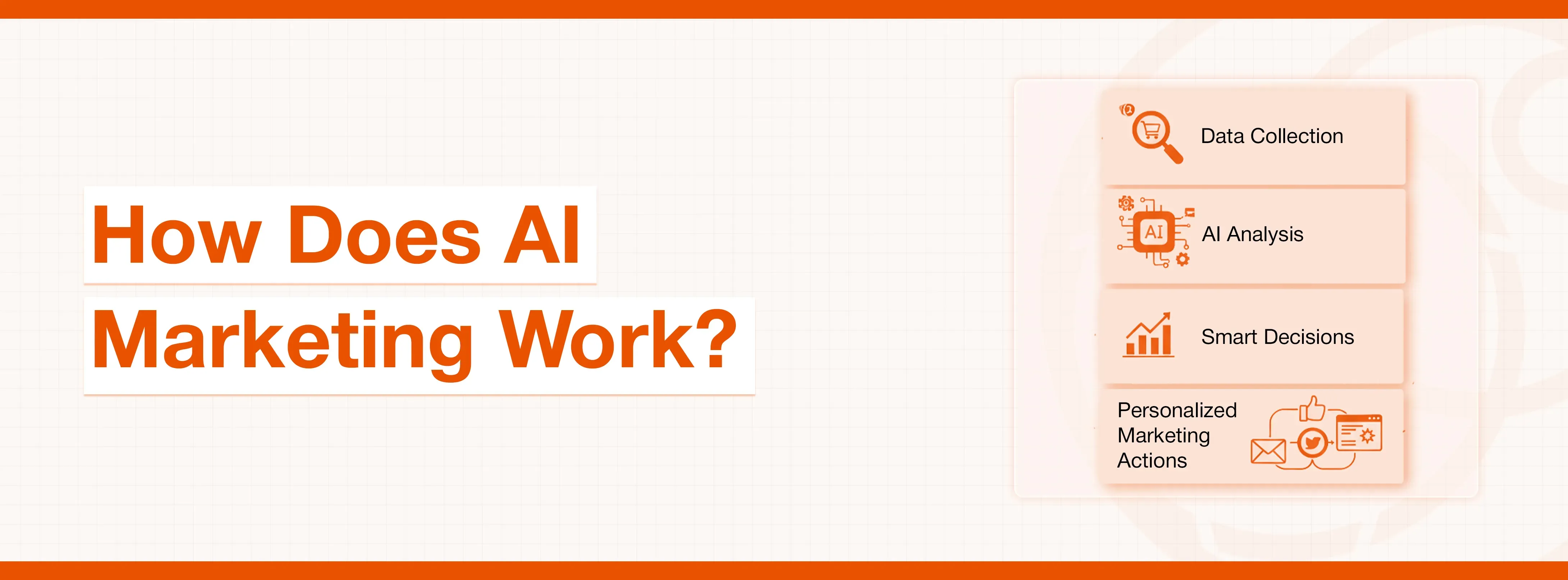
The only question is, what happens when AI marketing is applied in day-to-day situations? One may consider AI a cycle with no end.
Data Sourcing and Data Collection
The initial step in AI marketing is information gathering. AI systems retrieve information everywhere. This includes your website traffic, social media engagement, email open rates, and offline sales. AI can not learn without data.
Analysis and Pattern Recognition
After collecting the data, the role of AI in marketing shifts to analysis. It looks for patterns. For example, customers in a particular city purchase umbrellas every 3 days when the weather forecast indicates rain.
Automated Decision Making
This is when AI-driven digital marketing comes in particularly well. The AI can act on its own instead of instructing a human being on what it discovered. It can automatically increase the ad budget for umbrellas in that city just before rainfall. It is an ideal representation of how does AI marketing works to save time and prevent sales growth.
Machine Learning and Optimization
The final step is "learning." The AI reviews the outcomes of its activity. As long as the umbrella ads are working, it makes more of it. Otherwise, it changes the strategy. It is such a steady advancement that makes AI and ML in online marketing so effective.
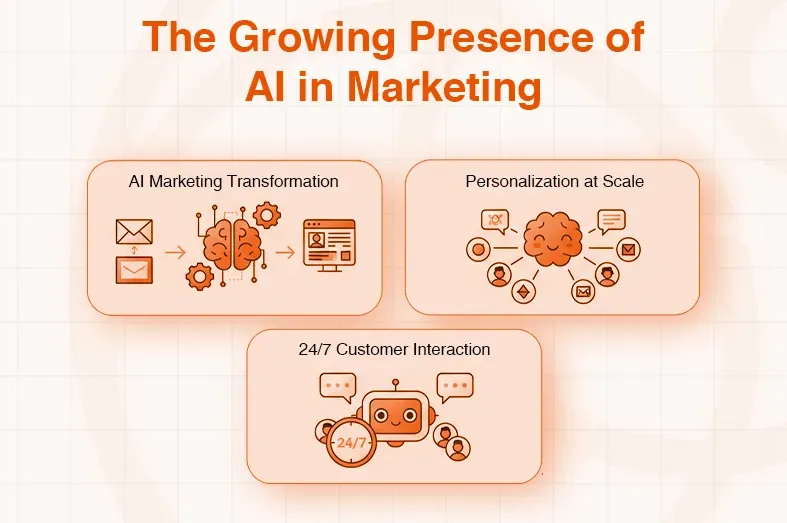
The Growing Presence of AI in Marketing
When discussing the role of AI in marketing, we refer to a complete industry revolution. It is no longer simply about sending an email and posting on social media.
Personalization at Scale
In the pre-AI days, it was only possible to personalize messages to a few individuals. Today, AI-based digital marketing can send a message to one million people simultaneously. Every message is personalized based on the individual's preferences.
24/7 Customer Interaction
Customer service is also involved in the role of AI in marketing. AI-powered chatbots can process several thousand customer requests simultaneously. They do not get exhausted, and they do not require rest. This keeps the customer happy and the brand active all the time.
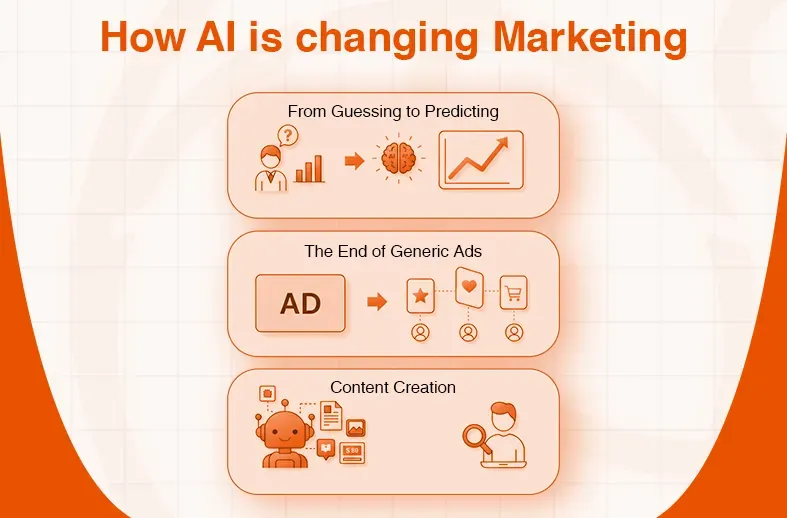
How AI is changing Marketing
You might be asking, " How is AI changing marketing? It is the transition from “reactive” to “proactive.”
From Guessing to Predicting
Previously, marketers looked at what happened last month to plan the following month. The changes provided by AI in digital marketing are now about the future. Predictive analytics can inform you of what a customer will do before they do it.
The End of Generic Ads
We are experiencing the impact of AI on marketing, as the generic Ads are vanishing. When you watch an advertisement today, there is a great likelihood that it was selected with an algorithm that specifically targeted you. This makes marketing feel like a suggestion to help rather than a “spam”.
Content Creation
Content creation is another way through which AI is transforming marketing. It is now possible to write simple news stories, make captions on social media, and even use AI to create fake images that look like advertisements. It would enable human creators to work on the high-level strategy and leave the repetitive writing jobs to the AI.
Major AI Digital Marketing advantages
As a business owner, you desire to see results. The advantages of AI in online marketing are obvious and quantifiable.
Greater Productivity: A single individual with AI tools can perform the job of a team of five.
Fewer Human Errors: When human beings are fatigued or bored, they commit errors. AI does not. It perfectly follows the data.
Cost Savings: AI tools require money; however, the money saved by not spending it on the wrong audience is much greater.
Enhanced Customer Intelligence: AI can inform you why you have lost a customer. This knowledge is crucial for the enhancement of your business.
Real-Time Responses: Everything in the digital world is a matter of speed. AI enables you to react to the action of a customer as soon as it occurs.
The advantages of AI in digital marketing are all focused on the same thing, which is that the smarter your marketing, the higher your profit.
The difference between AI and ML in Digital Marketing
In many cases, individuals confuse AI and Machine Learning (ML) and assume that they are synonymous. The difference is the key to truly knowing how does AI marketing work.
Artificial Intelligence (AI): The “big picture”. The concept of machines that can perform tasks in a manner that would be perceived as smart.
Machine Learning (ML): A specific subfield of AI. It is the training of a machine to learn from data in order to make improved decisions in the future.
In AI-driven digital marketing, AI is powered by ML. For example, your Facebook advertisements may be left to AI. The ML component of the system learns which colors or headlines receive the most clicks and automatically adjusts the ads.
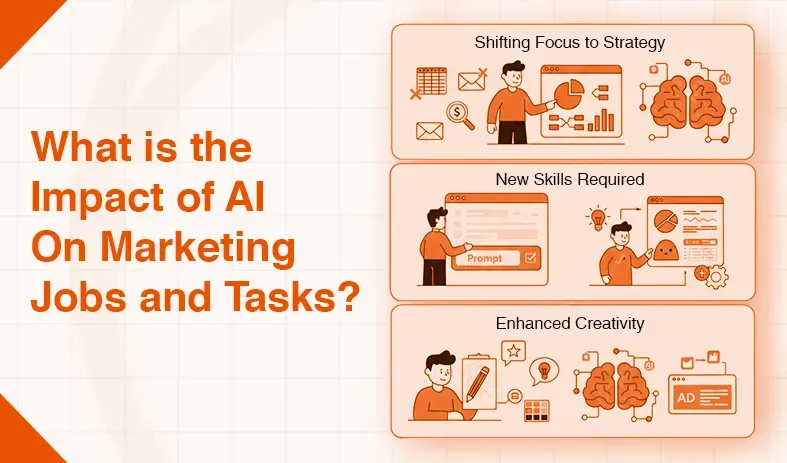
What is the Impact of AI on Marketing Jobs and Tasks?
One of the most widespread fears is that AI will destroy jobs. But when you consider how does AI affects marketing, it is more of changing jobs than destroying them.
Shifting Focus to Strategy
The marketers do not need to take hours cleaning up email lists or bidding on the keywords manually. The implication of AI on marketing is that human beings can now concentrate on the Why, rather than the How.
New Skills Required
To succeed in today's world, it is essential to understand how to use AI in marketing. This implies that one has to learn to provide AI with proper instructions (prompts) and learn how to process the data that the AI generates.
Enhanced Creativity
Since AI works with data, human individuals can have more time to be creative. The way AI is transforming digital marketing is that it provides us with increased time to create a better story and a better brand identity.
A step-by-step guide to using AI in Digital Marketing
When you are ready to start, here is a guide on how to use AI in digital marketing for your own business or clients in an effective way.
Step 1: Identify Your Goals
Do not use AI simply because it is a trend. Question yourself: Would I like to increase the traffic to my website? Do I want to close more sales? Would I like to have better customer service? The awareness of your objective will assist you in making the correct selection of digital marketing tools for AI
Step 2: Begin with Email Automation
One of the simplest ways to discover how AI marketing works is through email. Use the tools that are automatic in sending emails when a user does something on your site. In case they add a product to their cart, AI reminds them via email to purchase it.
Step 3: Implement a Chatbot
A chatbot is a quick method of realizing the potential of AI in digital marketing. Your website can have a basic chatbot that responds to “Where is my order?” or "What are your hours?" instantly.
Step 4: Use AI for Content Ideas
In case you are in a tight spot, have an AI brainstorm. AI could see what is trending in your industry and provide you with 50 ideas for blog posts in a few seconds. It is one of the best illustrations of how one can use AI in marketing to beat the competition.
Step 5: Analyze the Data
One month later, audit the work of the AI. Take the insights and make your future campaign even better. This is how AI is revolutionizing digital marketing: it is a cycle of continuous growth.
How to utilize AI to improve marketing?
To make the best use of your budget, you should be more familiar with how to use AI in marketing. These are the three sophisticated strategies.
Predictive Lead Scoring
Customers are not always the same. Digital marketing with AI and ML can analyze your leads and identify those most likely to make a sale. This gives your sales team a chance to make only calls to those people who are willing to spend money.
Dynamic Pricing
When you are selling products online, you can modify your prices in real-time with the help of AI. In case of high demand and low stock, the AI will be able to increase the price. When you have excess stock, you have the opportunity to provide a discount to certain individuals. That is the way AI marketing works to maximize profit.
Sentiment Analysis
The AI can scan through social media comments and reviews to determine whether people are pleased or dissatisfied with your brand. This is an AI impact on marketing, in which you can resolve issues before it becomes a PR crisis.
AI in Digital Marketing for Small Businesses
There is no need to have a million-dollar budget to enjoy the benefits of AI. AI transforms businesses by making advanced tools accessible to all.
Leveling the Playing Field
Previously, data scientists were only affordable by large companies. A small coffee shop can nowadays utilize AI-driven digital marketing tools to deliver coupons to local customers. This is a significant change in the way AI impacts marketing in favor of small businesses.
Automated Social Media
The owners of small businesses are busy. Artificial intelligence can now auto-schedule posts, auto-select hashtags, and even auto-reply to simple comments. It is a big part of AI applications in online marketing when you work alone.
Real-life examples of the impact of AI in Marketing
To see how does AI marketing works, we will first examine some of the industries that have been completely changed.
The E-commerce Industry
Recommendation of products in online stores is done using AI. The “People also bought” section is also AI and ML in action when it comes to digital marketing. It boosts the average order value without human intervention.
The Travel Industry
In the same way, airlines and hotels utilize AI to anticipate the desire of people to travel. They do this to price and direct targeted vacation offers. This is one of the major ways through which AI is transforming marketing in the travel industry.
The Entertainment Industry
Streaming companies such as Spotify or Netflix are basically massive AI engines. They rely on the whole marketing strategy, which consists of recommendations. This is a huge AI influence on marketing since it keeps users subscribed for over a number of years.
How AI will Change Marketing in 2026?
What will become of AI and its impact on marketing in the coming years? We are headed in the direction of the Agentic AI. This implies that AI will not just recommend an advertisement, but will speak to the client, bargain a price, and make a sale on its own.
The AI influence on marketing will also be transferred to Visual Search. Before long, the customer will be able to take a picture of a pair of shoes on the street, and an AI will be able to find them immediately in stores and offer a personalized discount code.
AI will also be able to make personalized video ads in which your favourite products are shown. But as AI advances further, the matter of ensuring privacy and keeping ethical boundaries will become important. There will be a need for balance between “personal” and “creepy.”
Conclusion
The most crucial step in the modernization of your brand is knowing how AI marketing functionality works. With a concise definition of AI marketing, it is possible to perceive the purpose of AI in marketing as an efficiency tool. Learning how AI marketing works will assist you in understanding how to apply AI in online marketing to achieve more.
The overall AI influence on marketing is how AI is transforming marketing towards the positive. And, regardless of whether you are interested in how AI will apply to marketing in future years, you need to adopt these tools. The knowledge of the working of AI marketing will ensure that your company stays relevant and successful.