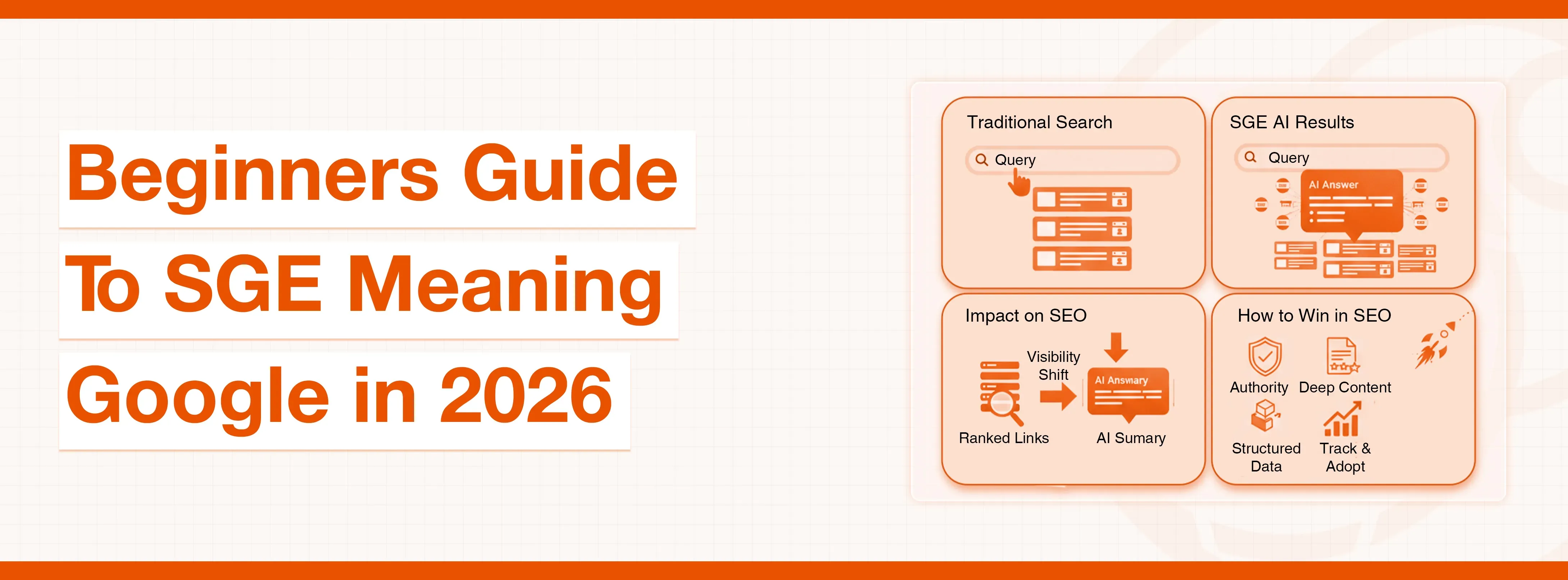
SGE (Search Generative Experience) is an AI-based feature of Google that produces detailed answers directly in search results, radically altering the way people search and websites gain exposure. In contrast to regular search, where web pages are displayed, Google SGE AI integrates information across various sources to generate conversational responses, which are displayed on the SGE SERP ahead of organic search results.
With the introduction of artificial intelligence into search engines, the digital world is undergoing a revolution. If you are searching for the true SGE meaning and how it impacts your brand, you are not alone. Search Generative Experience is the bold move of Google to AI-based search results, which essentially transforms the way in which individuals seek information as it appears on the Internet. This is not a simple update, but a complete redesign of the entire search ecosystem and a development that is compelling businesses to reconsider the way they use search engine optimization strategies.
Knowing what SGE is and its impact on your online presence is now mandatory for anyone who cares about digital marketing. The Google Search Generative Experience is an advanced AI-driven technology that provides conversational, all-encompassing answers at the top of the search results, usually ahead of organic search results. This implies that ranking on page one is no longer guaranteed to be as visible as before. This is a full guide to everything you need to know about Google SGE, its effect on SEO, and how to adjust to this new age of generative search to succeed.
What Is SGE and How It Works?
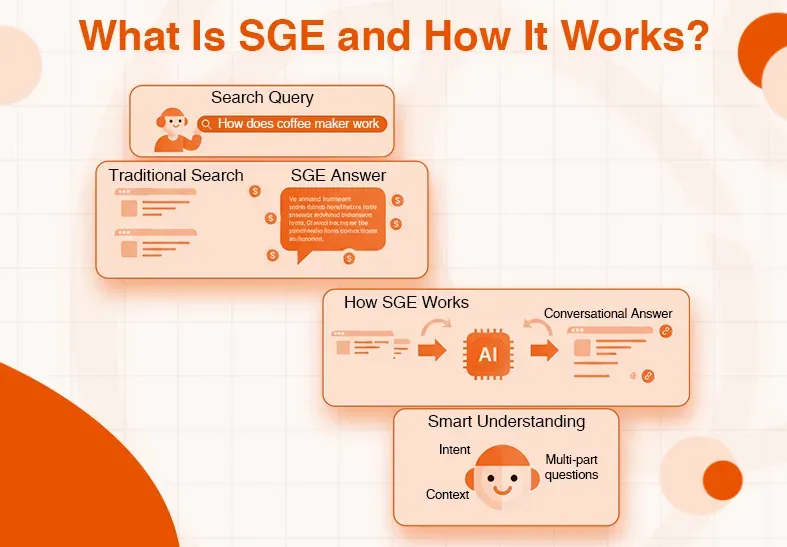
SGE is an acronym for Search Generative Experience, an artificial intelligence-based functionality that creates full-fledged, conversational answers to search queries right on the Google search result page. In contrast to traditional search results, which merely provide a list of relevant web pages, Google SGE AI synthesized answers, analysing and combining information presented by sources widely spread on the web.
When a search using SGE is performed, you will find a response provided by AI at the top of the search results, and usually an additional reference link to the sources used. This AI-based search engine uses the cutting-edge language models at Google to comprehend context, purpose, and subtlety in a way that never occurred to traditional keyword matching. Complicated, multi-part questions can be tackled, and detailed descriptions are given in the system, which seems more like a conversation with a professional than browsing through various websites.
The technology behind Google Search Generative Experience is a combination of years of machine learning and natural language processing. It does not simply memorize information but comprehends associations between ideas, judges truthfulness, and integrates the knowledge of different points of view. This feature enables SGE to address questions that could once have made the user visit multiple websites and compile information on their own.
The effect of SGE on the Search Results Page
The SGE SERP (Search Engine Results Page) appears radically different than what we have become used to in the last 20 years. The more conventional organic ranking is pushed farther to the right of the page, occasionally even after scrolling past the artificial intelligence answer. This change bears important implications for the click-through rates and organic traffic patterns.
The AI-generated answer box is positioned at the top of the search results in a normal SGE SERP, which has expandable sections with more information, a carousel of source citations, the dialogue follow-up prompt, and then the usual organic results. The new layout focuses more on holistic responses rather than single visits to websites, which essentially changes the behavior of the users and interaction patterns.
Search Generative Experience visual design focuses on text clarity and information density. Users may look at the summary generated by AI either as a quick scan or explore the specifics of the topic with expanding sections or access source websites to find out more information. This multifaceted strategy towards information provision is the way Google envisions the future of search, whereby answers are delivered first and visiting websites is optional, not mandatory.
The Relationship between Search Generative Experience and SEO
It is essential to know how Search Generative Experience and SEO are related to each other to sustain and increase online presence. Traditional SEO was designed around the ranking of certain words and attaining a place on the first page of search results. Although these basics are still essential, SGE SEO demands a more advanced framework that takes into consideration the way AI systems analyze, perceive, and reference content.
Google SGE AI does not examine the density of keywords or backlink profile alone but evaluates the overall quality, authority, and relevance of material in a manner that approximates the process of human judgment. It implies that the low-value, keyword-stuffed material that could be ranked previously will find it hard to receive citations during responses on SGE. Rather, detailed, well-researched content that exhaustively covers issues in several facets becomes fundamental.
The content creators have to consider the possibility of becoming the authoritative source that the AI systems are interested in referencing. This means writing content that directly responds to questions, offers original information or knowledge, shows mastery by being detailed and factual, and it also has a clear and logical structure that is easily interpreted and comprehended by AI. The aim is no longer rankings and instead becoming citable, getting those desirable reference links in SGE answers.
SGE Performance Analysis using SGE Analyzer Tools
Due to the increasing popularity of Search Generative Experience, new tools have appeared to assist marketers in comprehending their performance within this new environment. An SGE analyzer can assist you in keeping track of when your material is used in AI-generated answers, the secondary sub-queries SGE triggers for your target keywords, how your competitors are doing in generative search, and what sort of content SGE will choose to cite.
A variety of specific tools have appeared to satisfy this requirement. Solve by Saaga is an all-encompassing platform that is uniquely dedicated to the analysis of SGE, featuring a deep analysis of the performance of your content in AI-generated answers. Additional interesting tools are the generative AI tracking capabilities of BrightEdge and the experimental SGE monitoring capabilities of Semrush. These tools can give you the information you require to know and to maximize your search in Google Search Generative Experience.
Such analytical tools will bring forth insights that would not be captured by the traditional SEO tools. They demonstrate the precise language SGE applies to mention one of your works, where your site is found in the answer to an AI query, and how Google SGE AI chooses and shows information. For example, with Solve by Saaga, you can follow the appearances of keywords in SGE, cites of your competitors, and any gaps in your content where you might want to be better recognized.
This information is priceless in the optimization of your content strategy and can be significantly more visible in the new search paradigm. To effectively use an SGE analyzer, you have to know what measurements are important. The frequency of citation is a way to determine how many times your content is used in response to AI. Position in SGE indicates the location of your reference in the list of references. The query coverage indicates the percentage of your target keywords that result in a response from the SGE that includes your content.
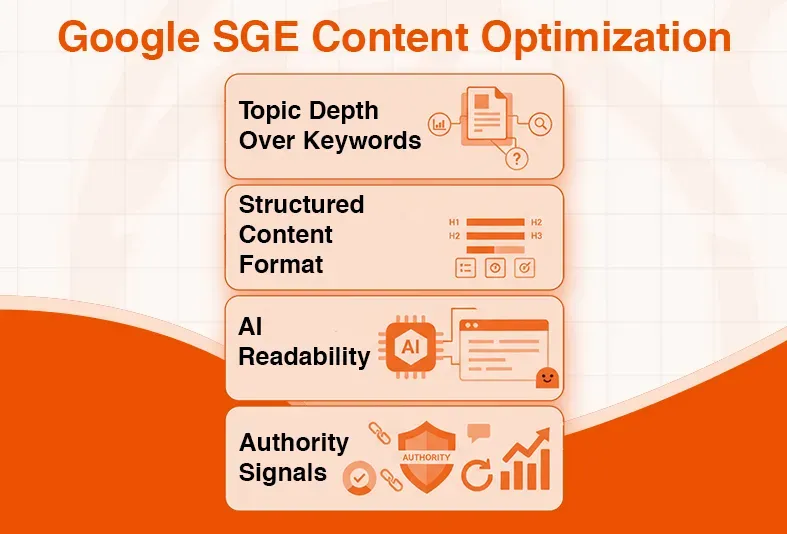
Google SGE Content Optimization
Producing content that succeeds in the Google Search Generative Experience will demand some strategic changes. Emphasis should be laid on covering the topic in detail, instead of being narrow in using keyword phrases. The SGE prefers content that covers the same topic in a multi-angle manner and offers all the information under one roof.
In SGE optimization, structure plays a very important role. Make distinct headings that indicate changes in topics and subtopics. Divide complicated information into small portions using descriptive subheadings. Provide examples, statistics, and quotes from experts that make it credible and more comprehensive. The AI must be able to capture the most topical information in your content with ease, and this can be achieved through proper content organization.
Signals of authority are increasingly important in generative search. Show authority by providing credentials of the author, citing credible sources to statements and statistics, staying accurate in facts, and updating the content frequently, offering an opinion or a different angle to the issue that is not available elsewhere. Google SGE AI is focused on high-quality content in synthesizing responses. Building your expertise is critical in gaining citations.
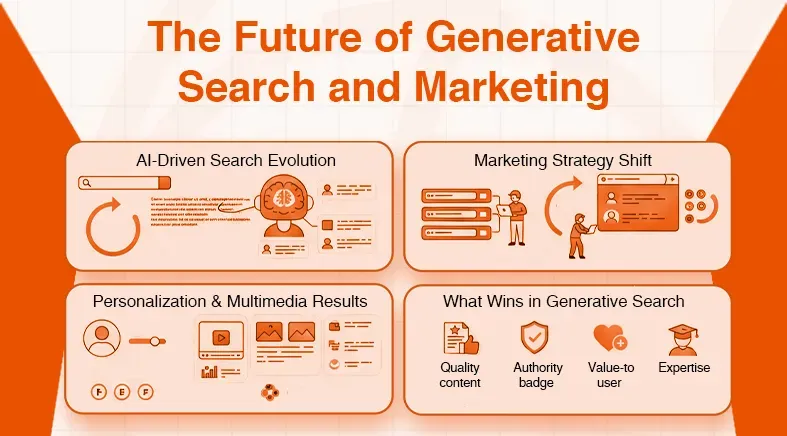
The future of Generative Search and Marketing
The direction of the generative search is aimed at further advanced AI inclusion in search results. In the future, we can expect more personalized SGE responses, guided by their user history and preferences, more multimedia content in AI-generated responses, extension to a wider range of query types and languages, and a higher capability of understanding complex or subtle queries.
To marketers, this development translates into constant changes in strategies to keep up with their visibility and relevance. The companies that survive will be those that do not oppose AI-assisted search. This does not imply the rejection of traditional SEO but simply the idea of broadening your strategy to include not only ranking in terms of keywords but also getting cited in AI-created answers.
Think about SGE user-wise, it is all about improved and quicker response to queries. By achieving the purpose of assisting users in finding the information they need, which is the objective of your content strategy, you are well-positioned, no matter what may happen to search. Quality, authority, and user value were never truly new SEO concepts, and they are increasingly important in the generative search era.
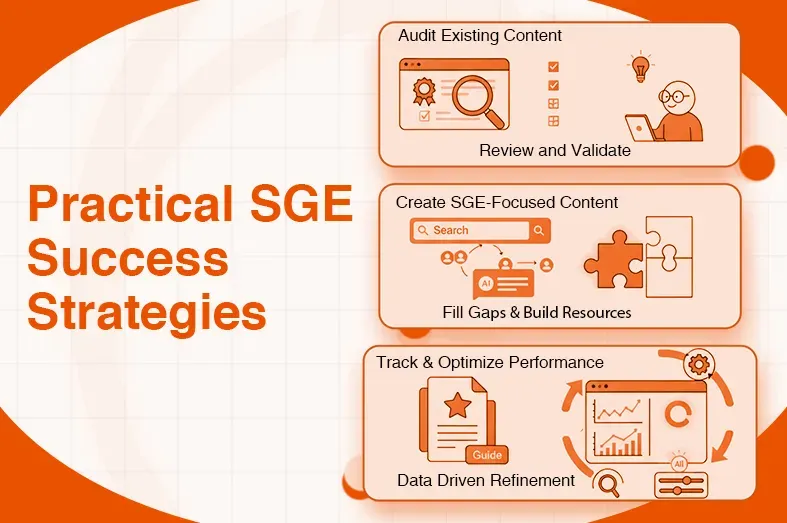
Practical SGE Success Strategies
Begin by conducting an audit of what you already have through the prism of SGE. Ask yourself: does every piece completely answer your reader or audience's questions, does it offer some sort of original value or insight, does it display expertise and authority, and is it structured in a way that allows the reader or listener to extract information easily? The content, which does not match these requirements, must be updated or replaced.
Think of SGE when creating new content. Find out what questions evoke the most SGE answers within your industry, what sources Google SGE uses most often, what blanks remain in the current AI responses, and where you can answer better, and develop comprehensive resources that will become the termination of the answers to significant questions in your field.
Regularly track performance based on both the standard SEO metrics and the SGE performance analytics. Follow the variations in organic traffic trends as SGE grows, track the frequency of your content in AI-generated responses, determine what content types and subjects do well in generative search, and change your approach based on real performance data and not on assumptions.
Common Problems and Their Solutions
A major issue that most companies find to be a challenge is lowered click-through rates because users are able to get answers through SGE without visiting web pages. Overcome this by producing content that naturally stimulates more exploration, providing tools, calculators, or interactive content that SGE cannot replicate, building unique data or research that users desire to obtain themselves, and building brand recognition so users actively seek out your site.
Another obstacle is the role of E-E-A-T (Experience, Expertise, Authoritativeness, Trustworthiness) in defining which content Google SGE AI refers to as the cited information. Enhance these cues by emphasizing author credentials and expertise, engaging in strict fact-checking and source citation habits, updating content regularly to maintain its accuracy, and establishing topical authority by covering your niche thoroughly.
The fast nature of Search Generative Experience itself is a challenge to sustaining effective strategies. Something that works today may require some modification tomorrow as Google perfects its AI systems. Be updated by tracking official Google changes and communications, engaging in search engine social communities on SGE alterations, experimenting with various strategies and evaluating outcomes, and keeping your content strategy versatile.
Conclusion
Learning SGE's meaning and its implications on digital marketing is one of the greatest challenges of any business today. Search Generative Experience is not a simple update to an algorithm; it represents a complete redesign of search engine services to consumers. The distance between companies that adjust their strategies and those that stick to the old models will increase as Google SGE AI becomes more advanced and popular.
The positive news is that the key principles of success in generative search coincide with the key requirements of good content: the information is thorough, the expertise is shown, the structure is clear and easy to understand, and the content has to bring some real benefit to the users. With these basics in mind and keeping up with SGE-specific best practices, you will find your business prosperous no matter how search might be changing. The next generation of content strategy is already in the hands of those who welcome change, never cease learning, and make the user's needs central to their strategy. Begin to optimize towards Google Search Generative Experience today, and you will have a base to survive in the AI-powered search environment of tomorrow.