To bridge the gap between traditional search and AI-driven discovery, brands must leverage the best answer engine optimization solutions for AI tech to ensure their content is cited by platforms like ChatGPT, Perplexity, and Gemini. Unlike traditional SEO, which focuses on ranking in a list of links, AEO prioritizes becoming the single synthesized response provided to high-intent users. By implementing technical foundations such as multimodal schema and explicit crawler permissions, AI companies can transform their high-quality content into authoritative citations. Real-world data shows that this transition can influence up to 32 percent of sales-qualified leads, effectively shortening the buyer journey and ensuring your brand leads the conversation rather than being left out of the AI response.
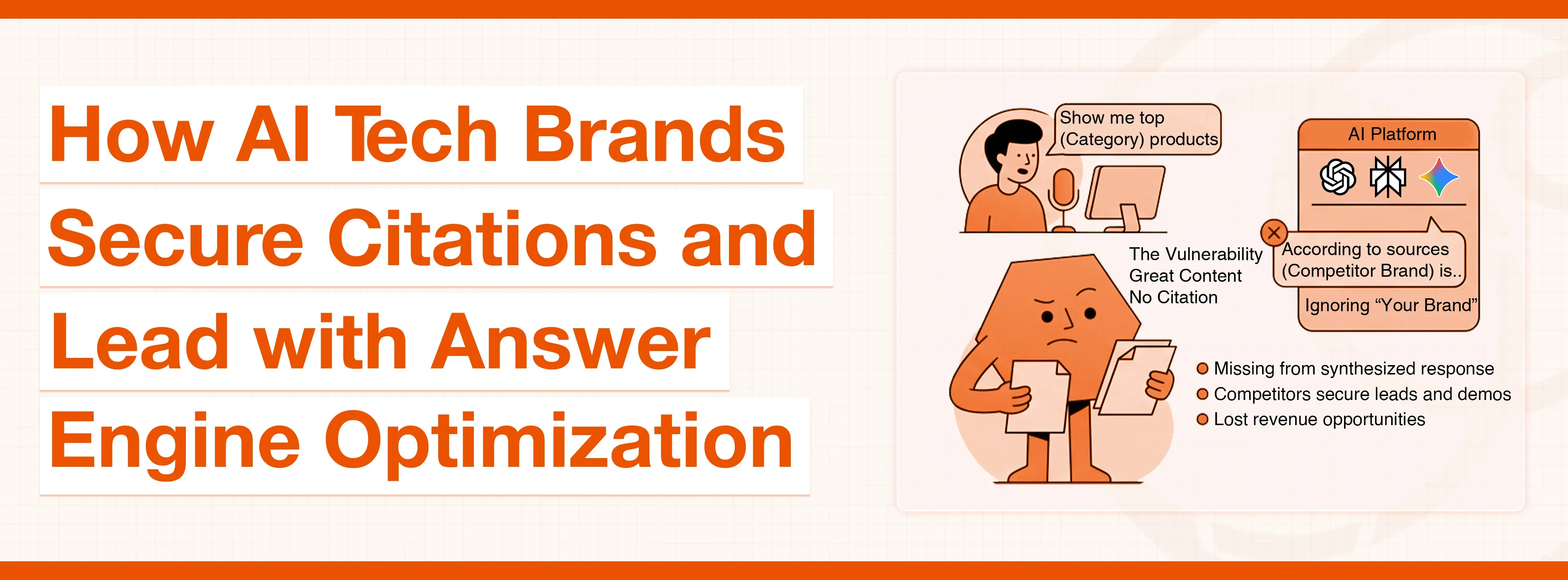
AI technology brands tend to have good websites, high-quality content, and strong value propositions. These resources have a good market standing. Nevertheless, there is one key weakness in the modern digital environment. If one of the potential buyers asks the AI platform about a particular product category, there is a chance the brand will not appear in the answer. Competitors secure the lead. Other entities book the demos. However, the missing brand might have better content.
This vulnerability can be resolved through Answer Engine Optimization, which is also known as AEO. It can be defined as the habit of increasing brand awareness and reputation on AI-based platforms like ChatGPT, Perplexity, Google AI Overviews, Claude, and Gemini. The main task is ensuring content citation when making high-intent queries. The practice helps to reach buyers who are in need of the relevant products and services. The increased levels of citation with regard to relevant queries translate to the steady occurrence before the right audiences.
A Quick Overview of AEO
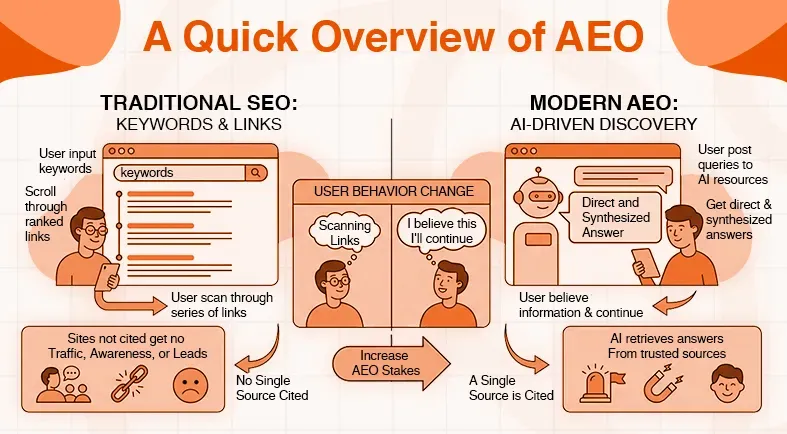
Answer Engine Optimization is one of the solutions to the inherent changes in information retrieval. In the past, users used to input keywords in a search engine and scroll through ranked links. Nowadays, there is an increasing number of people who post queries to AI resources. Their answers are direct and synthesized in nature. No list of links appears. No scrolling occurs. Immediately, the answer is provided. It is retrieved using sources that are trusted by the AI system.
These direct responses are appreciated by the users. This taste does not indicate that it is dwindling. This development has a great implication for SEO professionals and content marketers. In many instances, a single source is cited in the AI answer. Other brands do not feature in terms of the quality of content. When a site is not referred to, the search query will not bring traffic. It yields no brand awareness. It produces no leads.
The behavior of the users about AI responses and their behavior about search results are different. Users tend to scan through a series of links when they have a list of links. Users are likely to believe the information and continue when an artificial intelligence provides an answer. Such a change in behavior increases the stakes of AEO.
The Difference Between AEO and Traditional SEO
The AEO and SEO overlap in certain aspects. They show divergence in ways that carry significance in practical application. Search engine optimization concentrates on the improvement of page rank within a listing of results. The answer engine optimization concentrates on the inclusion within the answer itself. In the case of traditional search, a user observes ten competing pages. In the case of an AI response, the user observes one answer that is drawn from trusted sources. The remainder of the web stays invisible.
The signals that drive each outcome show a meaningful difference. The traditional SEO provides a reward for keyword relevance and accumulated domain authority. The AEO provides a reward for content clarity and thorough subject coverage. It provides a reward for claims that can be verified. It provides a reward to the organization that enables AI navigation and extraction. The AI platforms evaluate these qualities through the application of the E E A T framework. This stands for Experience, Expertise, Authoritativeness, and Trustworthiness.
The AEO does not take the place of traditional SEO. The domain authority and external link signals that are built through SEO provide the foundation of credibility that the AI platforms rely upon. The SEO creates the conditions under which the AEO functions. The two represent investments that are sequential in nature.
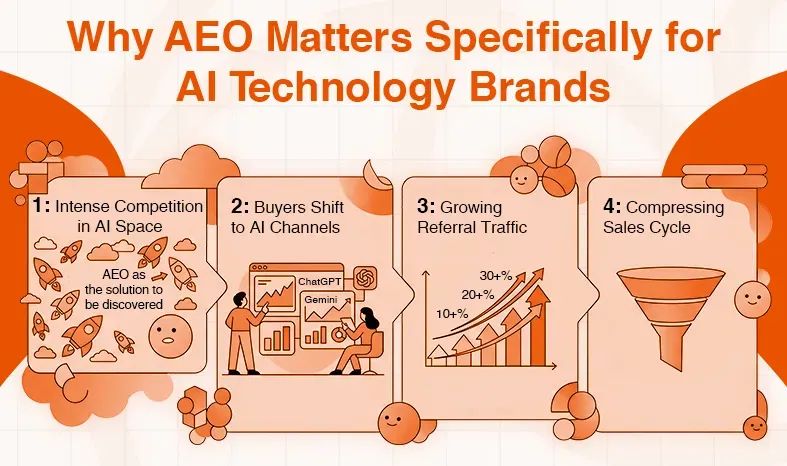
Why AEO Matters Specifically for AI Technology Brands
The competition in the space of AI technology has grown with intensity. Every category contains players that are more numerous and content that is more abundant than two years ago. The discovery of a brand requires effort that is considerable effort. A part that is meaningful of that effort must target the channel that buyers use first. The AI platforms represent this channel.
The individuals who make evaluations of AI software tools and SaaS products have moved away from traditional search in a manner that is decisive. They trust AI responses. They make purchasing decisions based on them. In the case when a brand does not appear in these answers, it is not part of the conversation that leads to a sale.
The data indicates growth that is significant in this channel. The AI-attributed referral traffic grew at approximately one percent every month throughout 2025. This data comes from the Conductor AEO and GEO Benchmarks Report. When compounded across a year, this channel affects revenue in a manner that is clear.
The Relixir.ai data shows that AI citations influence 32 percent of sales-qualified leads within six weeks. For companies that have sales cycles that are longer, this visibility compresses the awareness phase of the buyer journey. The choice not to invest in AEO is not a position that is neutral. It allows competitors to occupy the space that buyers inhabit.
What the Real World Data Actually Shows
The results that are documented move AEO from theory to a priority that is actionable. Several case studies illustrate the impact.
These results come from companies that operate in segments that are different. They used tools that are different. They targeted buyer profiles that are different. The consistency across conditions that are varied elevates this from anecdotal to significant in a strategic manner. The quality of leads improves when AI platforms recommend a brand. The velocity through the funnel increases.
Core AEO Strategies for AI Technology Companies
Three key areas require attention. The existing content programs do not need to start from scratch.
Structured Data and Technical Foundations
This is the part of AEO that is most direct and controllable. The impact is measurable and relatively quick. The FAQPage, HowTo, and Article schemas inform AI crawlers about page content and answer formats. The Maximus Labs data shows that combining multiple schema types on a single page produces a 30 percent increase in citation rates. This is known as multimodal schema implementation.
The technical requirements often get overlooked. The GPTBot and PerplexityBot require permission that is explicit in the robots.txt file. In the case when agents cannot access pages, they cannot cite them. The page load performance requires auditing. The JavaScript rendering issues must be resolved. These tasks are not glamorous in nature. Getting them wrong nullifies portions that are significant to the AEO effort.
Conversational Content Architecture
The AI platforms respond to questions that are natural and intent-driven. They do not respond well to keyword strings that are abbreviated. Buyers expect answers that are specific and well-reasoned. Content needs organization around topic clusters.
- Pillar Page: Covers a broad subject.
- Spoke Pages: Address questions that are subordinate and specific.
- Internal Linking: Connects pillar and spoke pages.
This structure creates the depth and coherence that AI platforms seek. The FAQ hubs and how-to content mirror the shape of questions that are natural. The comparison tables help AI platforms categorize entities in a manner that is accurate. Content should reflect the shape of a question that is actual of a user.
Topical Authority and Source Credibility
The AI engines prefer sources that cover a subject in a thorough manner. A website that addresses only part of a topic is less likely to be cited. The domain must read like a reference that is reliable. Tools like MarketMuse identify gaps in coverage.
The backlinks from external sources that are credible function as signals of trust.
The regular content updates signal freshness. For AI technology brands, mentions in professional communities provide validation that is third-party. This includes substantive Quora threads and credible subreddits. The on-page optimization cannot replicate this validation alone.
The Best AEO Tools for AI Technology Practitioners
The tooling landscape has developed in a manner that is quick. Solid options exist at every budget level.
Tracking and Analytics
Content Optimization
The question research tools include Also Asked and AnswerThePublic. They provide access that is free to People Also Ask query visualizations. The KeywordsPeopleUse extends this to query clusters that are multilingual.
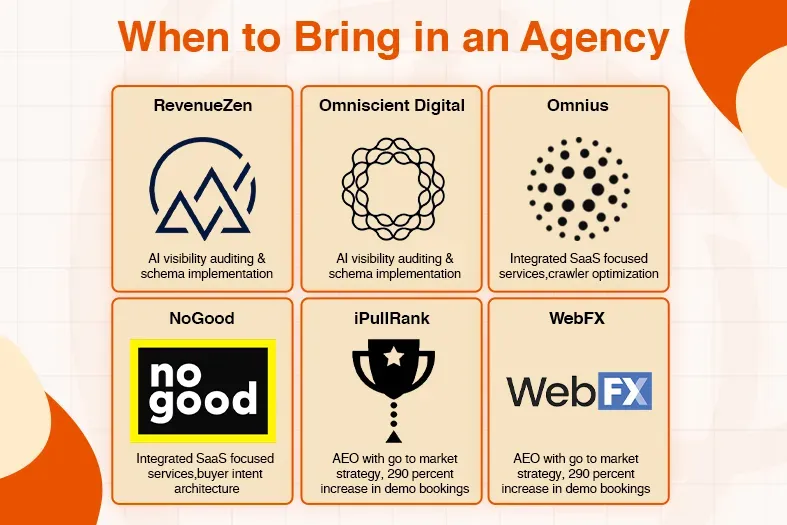
When to Bring in an Agency
The in-house teams have limits. The specialist support increases efficiency in areas that are certain areas. The large-scale schema deployment requires expertise. The thorough technical auditing benefits from specialization. The PR led outreach builds external citation signals in an effective manner that is effective.
- RevenueZen: AI visibility auditing and schema implementation.
- Omniscient Digital: AI visibility auditing and schema implementation.
- Omnius: Integrated SaaS focused services, crawler optimization.
- NoGood: Integrated SaaS focused services, buyer intent architecture.
- iPullRank: AEO with go to market strategy, 290 percent increase in demo bookings.
- WebFX: AEO with go to market strategy, 290 percent increase in demo bookings.
The agency partnerships produce results that are faster than in-house teams that stretch across too many disciplines.
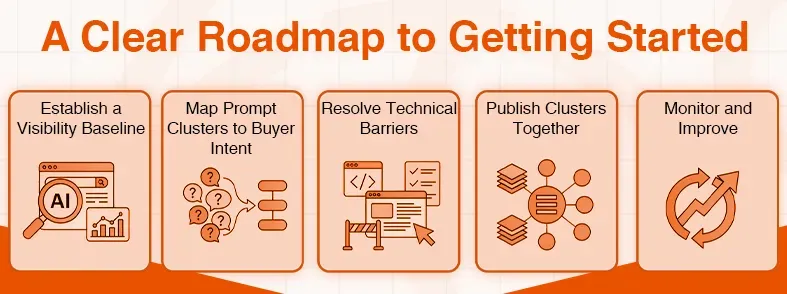
A Clear Roadmap to Getting Started
The understanding of AEO differs from the direction of effort in a manner that is effective. The following roadmap reflects how brands built outcomes from the ground up.
Establish a Visibility Baseline
- Audit brand appearance across queries that are relevant using LLMrefs or AIclicks.
- Record which AI platforms cite content and which do not.
- Identify the five to ten queries that are highest intent where the brand is absent.
- These queries are targets that are primary for pipeline growth.
Map Prompt Clusters to Buyer Intent
- Gather exact questions that buyers submit to ChatGPT and Perplexity.
- Use AlsoAsked or AnswerThePublic to surface questions of real users.
- Group questions into clusters that are thematic with a central pillar topic.
- Prioritize clusters where citations of competitors already exist.
Resolve Technical Barriers
- Deploy FAQPage, HowTo, and Article schemas across pages with citation potential.
- Update robots.txt to permit crawl access for GPTBot and PerplexityBot.
- Audit page load performance and fix JavaScript rendering issues.
- Confirm mobile rendering produces a structure that is clean and navigable.
Publish Clusters Together
- Release pillar and spoke content within the window of publication that is the same.
- Establish topical coherence from the start.
- Add internal links between all cluster pages.
- Use Clearscope to verify the required depth before publishing.
Monitor and Improve
- Track citation rates on a basis that is weekly.
- Look for patterns in queries that are moving.
- Note the structural and topical qualities of cited pages.
- Apply those qualities to pages that are underperforming.
- Begin corroboration outreach once the content foundation is solid.
Conclusion
These are outcomes that are documented and attributed to organizations that are real. They are not projections. None of these results required a strategy that is entirely new. They came from brands that understood where buyers looked. They structured content to be found there. They applied signals that are technical and topical that AI platforms trust.
This is a process that is replicable. It is not an event that is one-time. For SEO practitioners who work with AI technology brands, the starting point is clear. Audit current AI visibility. Identify gaps. Apply the schema to pages that are highest priority. Build topic clusters around questions of buyers. The methodology is proven. The tools are available. The commercial case is documented in a manner that is good. What remains is the decision to start.